![econlifelogotrademarkedwebsitelogo[1]](/wp-content/uploads/2024/05/econlifelogotrademarkedwebsitelogo1.png#100878)


How Does the Harry Styles Effect Impact Our Spending?
September 7, 2026
What We Can Learn From a $20 Burrito
September 9, 2026
Recently, a Starbucks customer complained about his iced chai. A longtime lover of the drink, he looked forward to ordering it two to four times a week. But during March, its sweet and spicy taste was gone. His “seven pumps of chai concentrate, seven squirts of sugar-free vanilla syrup” no longer worked.
Explaining why their iced chai had become bland, the barista said Starbucks changed the formula. Because increased customization was the chain’s “fresh focus,” its tea had to start with less so they could add more.
The decision sounds like New Coke.
When Innovation Backfired
Whereas in 1955 Coca-Cola sales were double those of Pepsi, by 1984 Pepsi was behind by only 4.9 percent. Furthermore, the combined sales of Diet Pepsi and Pepsi Light exceeded Coca-Cola’s Tab.
Concerned with its shrinking market share, Coca-Cola initiated Project Kansas. Its goal was to develop a new taste for Coke. However, assessing the consumer’s reaction to a newly formulated Coke was somewhat tricky because no one could actually disclose that the goal was a replacement for Coca-Cola. Field testing, therefore, had to be somewhat oblique. But the results were conclusive. People liked the new flavor and Pepsi drinkers even said they might switch.
So they proceeded with a new Coca-Cola formula.
On Tuesday, April 23, 1985, at New York’s Lincoln Center, in front of an audience of 700, Roberto Goizueta exclaimed, “The best soft drink, Coca-Cola, is now going to be even better.”
All appeared to go well until the questions began. Asked one reporter, “Are you one hundred percent certain that this won’t bomb?” Another said, “… if we wanted Pepsi, we’d buy Pepsi.” Afterward, the protests continued with Coke receiving eight thousand daily telephone calls. During a sports event at the Houston Astrodome, people booed the New Coke commercials that flashed across the viewing screens.
Soon they knew they had made a monumental mistake. Coke’s CEO Roberto Goizueta said that after he announced Coke’s decision, he slept like a baby: “I wake up crying every hour.” Quickly, they sought to minimize the damage. The decision was made to retain New Coke as a “sister” to the older version which henceforth would be known as Coke Classic.
Our Bottom Line: Competitive Strategies
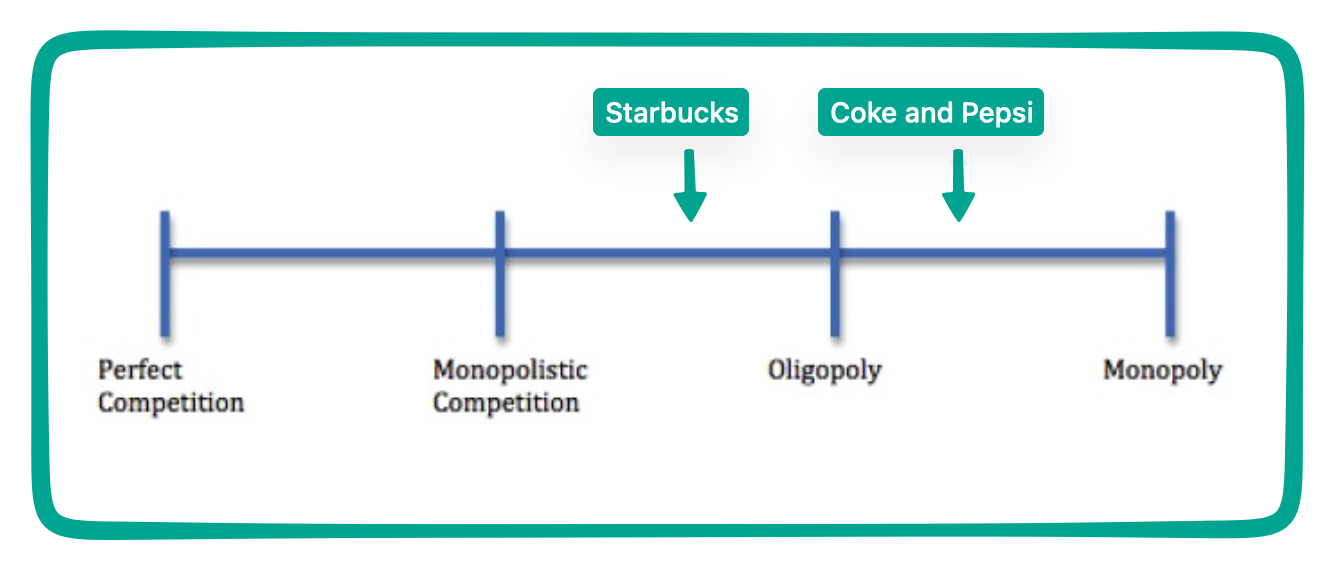
Whether looking at Starbucks’s monopolistic competition or Coke and Pepsi’s oligopolistic market, we see the power of the supply side. Rather than competing with price, they try to grab our attention with a new product.
One reason is their market structure.
Moving from left to right on our continuum of market structures, firms grow larger and more powerful. With perfect competition, we find markets populated by many small firms that produce almost identical products such as potatoes or asparagus. Next, monopolistic competition takes us to businesses that are somewhat larger like coffee shops and supermarkets. Coffee shops, for example, produce many of the same kinds of items but have something distinctive (iced chai) that gives them product differentiation. Then, with oligopoly, we have several large firms (like Coke and Pepsi) that are dominant, and finally, at the other end, monopoly takes us to a single firm’s dominance.
Perhaps, as we’ve said before, it all returns us to the power of the market…even to create a disappointing iced chai.
My sources and more: Thanks to the Wall Street Journal for inspiring today’s post with its iced chai article. Then, our New Coke facts and several sentences came from a past econlife post.
Please note that several of today’s sentences were previously published in a past econlife post.