![econlifelogotrademarkedwebsitelogo[1]](/wp-content/uploads/2024/05/econlifelogotrademarkedwebsitelogo1.png#100878)


Why Second Placers Are the Saddest Losers
July 13, 2026
How T. Rex Became a Multi-Million Dollar Dinosaur
July 15, 2026
Driscoll’s figured out how to sell us a seasonal fruit during the entire year. As a result, annually, they ship four billion containers to 60 countries.
They also know how to charge us more.
Strawberry Competition
Strawberry experts would tell us that there are many different kinds of strawberries. And indeed, berry seller Driscoll’s does the research and development that is supposed to develop new kinds of berries. But to most of us, like tomatoes and potatoes, all strawberries are alike. Still though, by labeling every container with its name, Driscoll’s differentiates its strawberries.
The result has been a pretty strawberry with okay taste. As Driscoll’s tells us, the berries with better taste were less resilient. “They were too soft, too susceptible to disease or their shelf life was too short. They weren’t red enough for consumers or efficient enough for harvesters. Or there weren’t enough of them.” According to a Driscoll’s CEO, “We threw out the absolute sweetest, best-tasting berries that we had in our whole gene pool…”
Now though, Driscoll’s has begun to offset the negative correlation between sweetness and yield. Called the “Sweetest Batch,” a pricier and more limited version of the strawberry is in our grocery stores.
Our Bottom Line: Competitive Market Structures
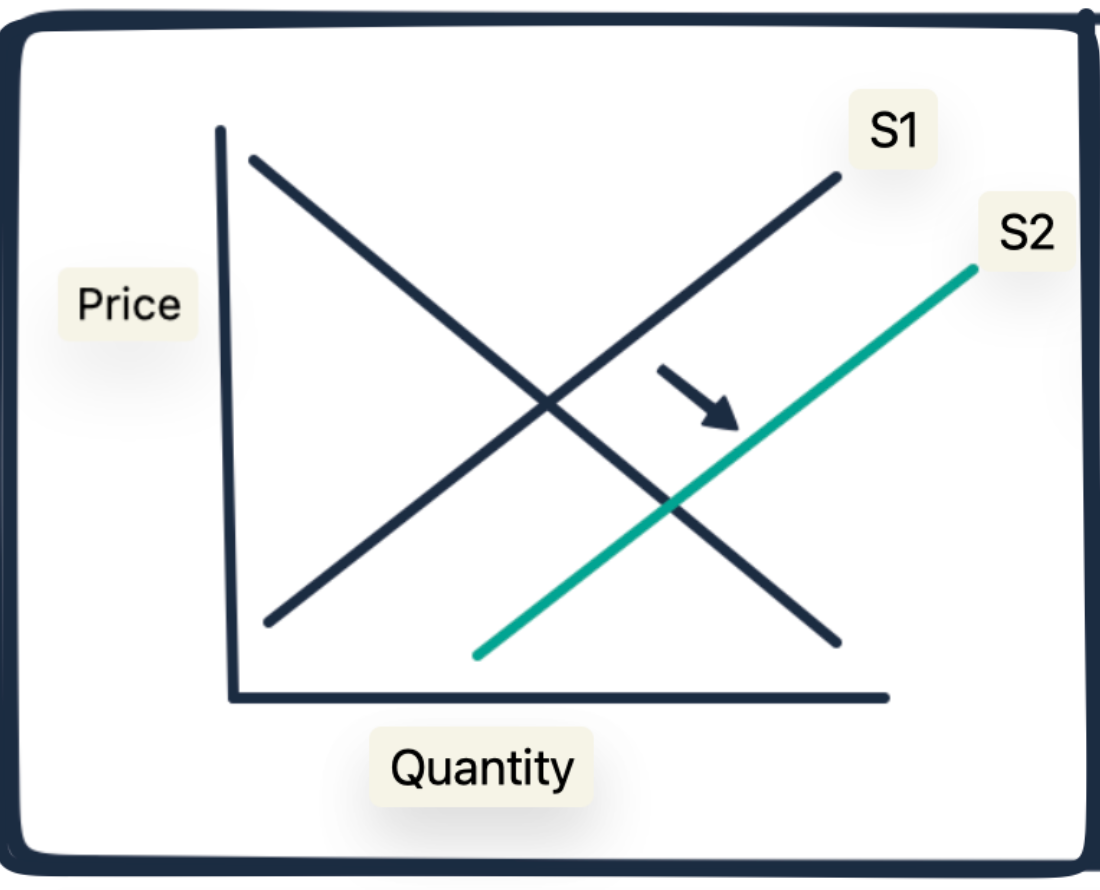
Most potatoes and tomatoes look and taste like other potatoes and tomatoes. So too do broccoli and asparagus and mushrooms. As a result, they compete in a perfectly competitive market structure. With perfect competition, businesses tend to be small with no pricing power. Instead, because many sellers and many consumers interact to determine price and quantity, the market is the boss. Equilibrium price tends to drop when profits rise because market entry is so easy that the allure of profitability erases it through increased supply.
Consequently, price drifts toward the producer’s costs. Below, when price was higher, it attracted new producers. However, their elevated profits rapidly diminished as the extra supply pushed equilibrium downward:
Driscoll, though, through its branding could avoid the downside of perfect competition. Instead, it has a position further to the right along our market competition scale even though all strawberries are pretty similar. On a competitive market continuum, Driscoll’s occupies a position that is far from perfect competition. At the right side of monopolistic competition, its strawberries reflect the blend of perfect competition with identical products but also something that is unique–the monopoly part:
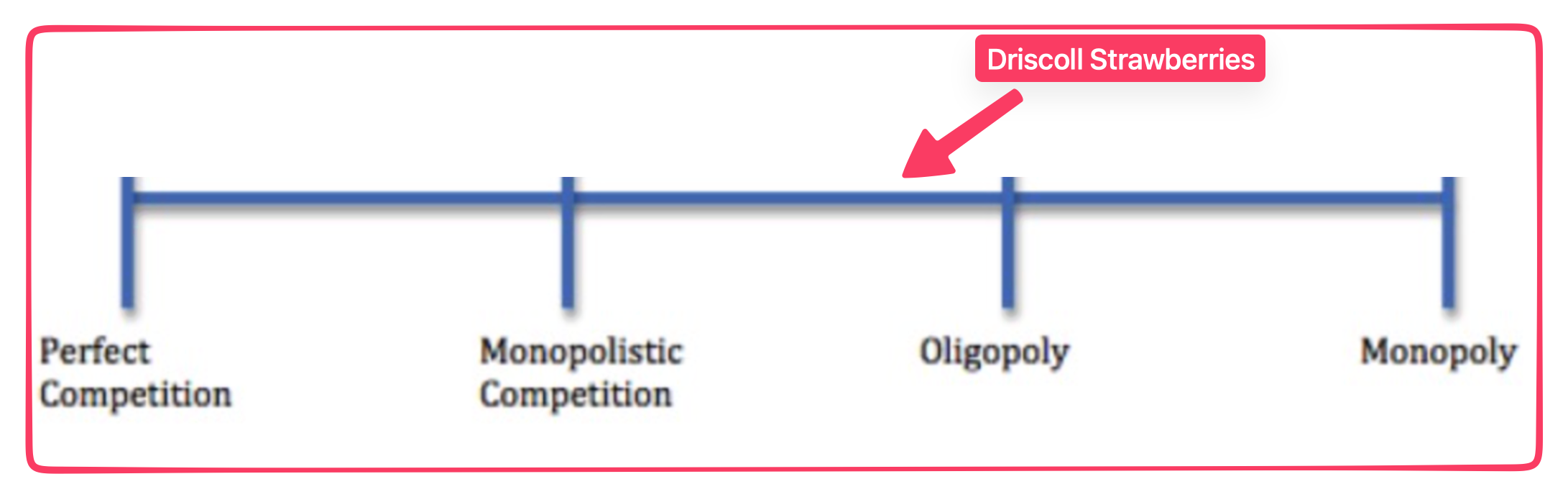
And now, especially through the “Sweetest Batch,” Driscoll’s proved its pricing power and its true exit from the powerlessness of perfect competition.
My sources and more: Thanks to the NY Times for inspiring today’s post. Next, from WSJ we leanred about the newer sweeter strawberries Driscoll’s developed. Please note that several of today’s sentences were in a past econlife post.