
Why Global Warming Is Worse for Women
November 9, 2026
It all sounded rather simple. On November 6th, the BLS reported that employers added 165,000 jobs and the unemployment rate was 4.1%.
But there is so much more.
The Employment Report
Revisions
Because some firms are slow to send in their data, the report has to revise the past. This month it meant adding 53,000 more jobs for August and 31,000 extra for September. Furthermore, we can ask if 165,000 jobs should make us smile when several years ago, the good numbers were above 200,000. The answer is yes because immigration fueled the jobs growth we used to enjoy. So we can say that the Trump administration policies were about more than immigrants. They also diminished jobs growth.
Kinds of Jobs
Since January 2025, we’ve added 1,044,000 jobs. Without health care and social assistance, however, the economy would have been down 19,000 jobs. In addition, because women dominate health care and social assistance, 77% of the new jobs went to women. As for manufacturing jobs, they slumped but more recently have climbed closer to 2024 levels.
the Math
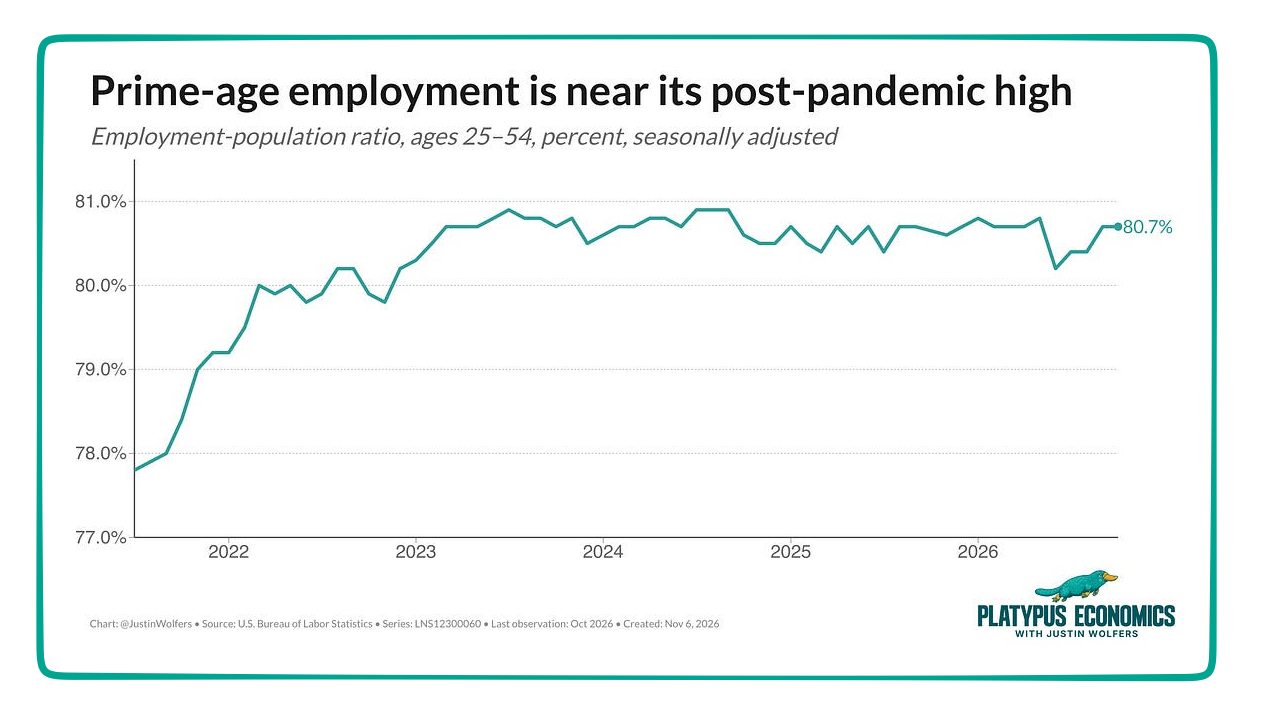
In addition to sufficiently robust jobs growth (discounting the immigration downside), the employment rate dipped from 4.2% to 4.1%. Here, it’s all about the math. Calculating the unemployment rate, we have the labor force (composed of people 16 or older with a job or looking for one) as our denominator. Consequently, when baby boomers retire our denominator shrinks. But the offset has been the prime-age employment that has remained steady at a post-pandemic high:
Wages
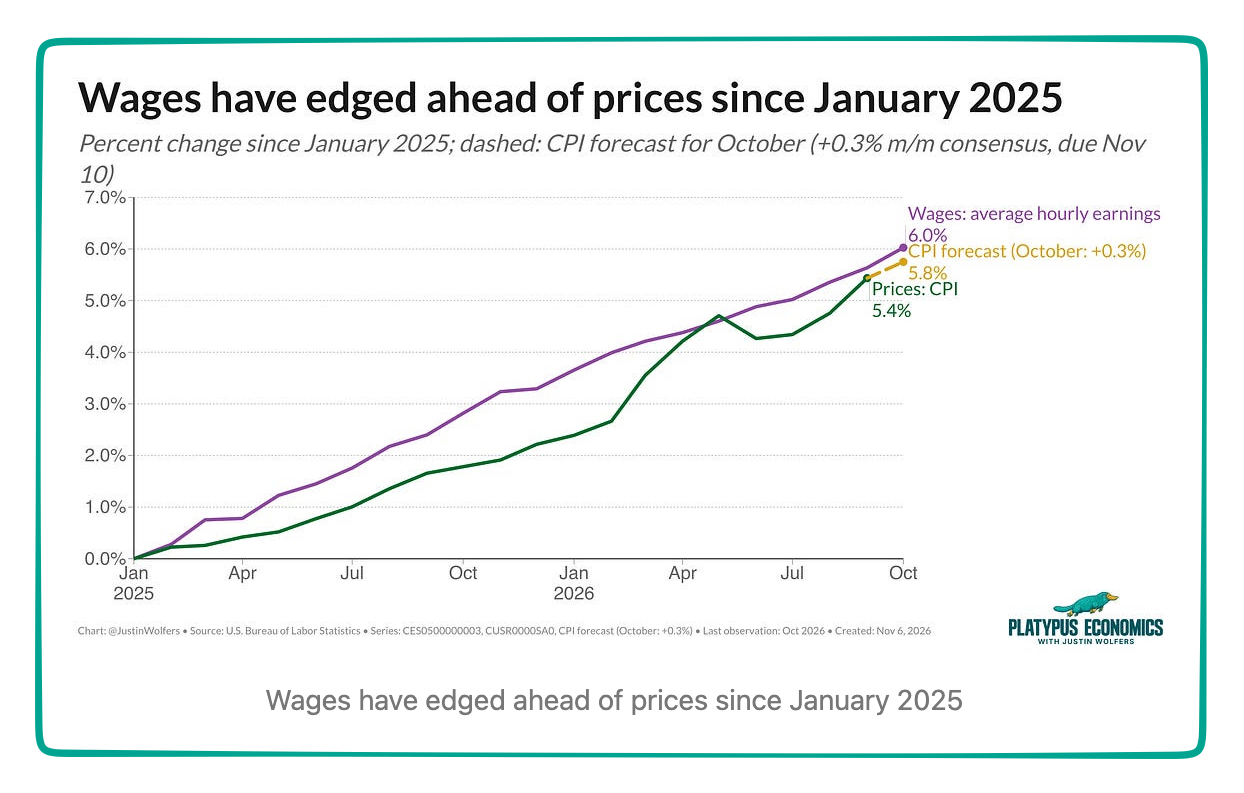
Most sadly, our gloomiest deep dive is how much we earn. The key here is surpassing inflation. However, with average hourly earnings up by 3.1% during the past 12 months, we have not. But it has been close. And it also depends on your job history. People who switch jobs tend to earn more than those of us who loyally stay in the same place.
Furthermore, it depends on your time frame. Below, because our time frame is since January 2025, wage growth is 6%:
With a deep dive that explores revisions, kinds of jobs, the math, and wages, we can return, as always, to Benoit Mandelbrot and the length of the British Coastline.
Our Bottom Line: The British Coastline
Fractal mathematician Benoit Mandelbrot once told us that the coast of Great Britain is much longer than we think. From a distance, it appears to be a smooth curve. However, an increasingly closer look reveals countless coves, crannies, and indents that make it much longer:

Similarly, the Employment Report is about more than an unemployment percent and the number of jobs added.
My sources and more: Always my favorite economist, Justin Wolfers, inspired today’s post. His deep dive into the employment report provided many of our facts and our subtopics. From there, the NY Times had a good employment report summary. However, I did not want to conclude without recommending a Journal podcast. Detailing 60,000 buyout offers, the podcast gives a close-up look at how one firm affects the employment report.