
The Economic Side of a Taco Bell Ultramarathon
November 27, 2026
Recently, SNL reminded us that sisters disproportionately carry the burden of eldercare:
As economists, we can call it a free rider problem.
Elder Care
Researchers estimate that sisters provide approximately three times more hours of care for their parents than their brothers. Here, male adult children could be taking advantage of the social norms that let them exit or minimize care. As a result, although some have hypothesized that it’s an earnings difference, it’s not.
At 77 hours a month, parental care is costly. However, the females bear the cost while all family members enjoy the benefit. Sounding at first like a human situation, instead, it’s about a series of strategic decisions that relate to location, work, and care. With location, adult children have to decide if the move makes sense. It also takes us to work, to earnings, and whether the job is full or part-time. And of course, we are looking at the care the parent requires. Daughters, they explain, experience more of a “net warm glow” from eldercare than their brothers.
Even if the sister has the greater opportunity cost, she provides more eldercare:
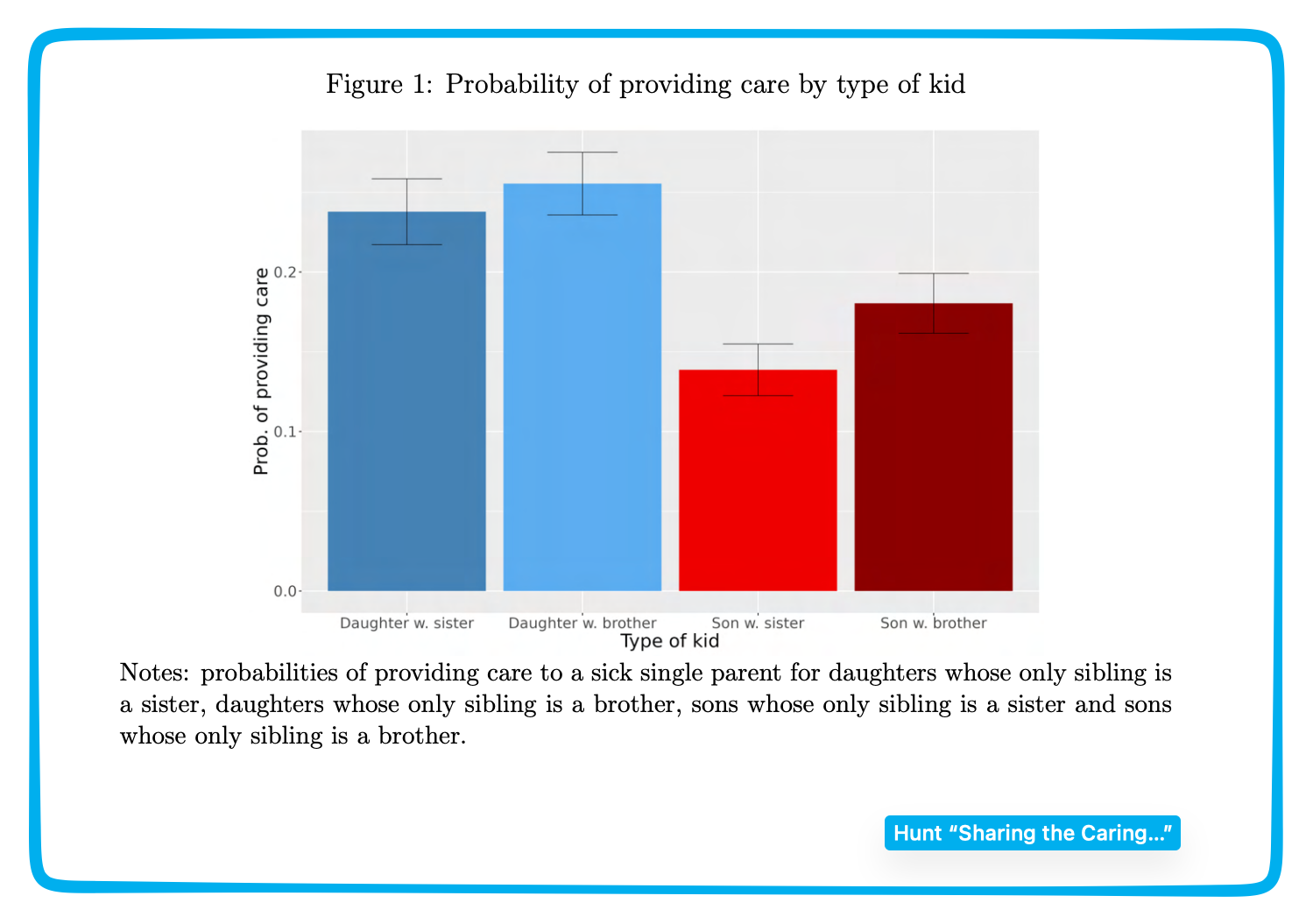
Furthermore, when a brother knows his parents prefer a sister’s care, she winds up providing it. Then, though, we wind up with a feedback loop. If one adult child gives more care, the other sibling gives less. Increasingly less from the brother means an uptick from the sister. The result? The gender care gap widens.
Researchers concluded that even when there is no income gap between sons and daughters, the daughters do more eldercare:
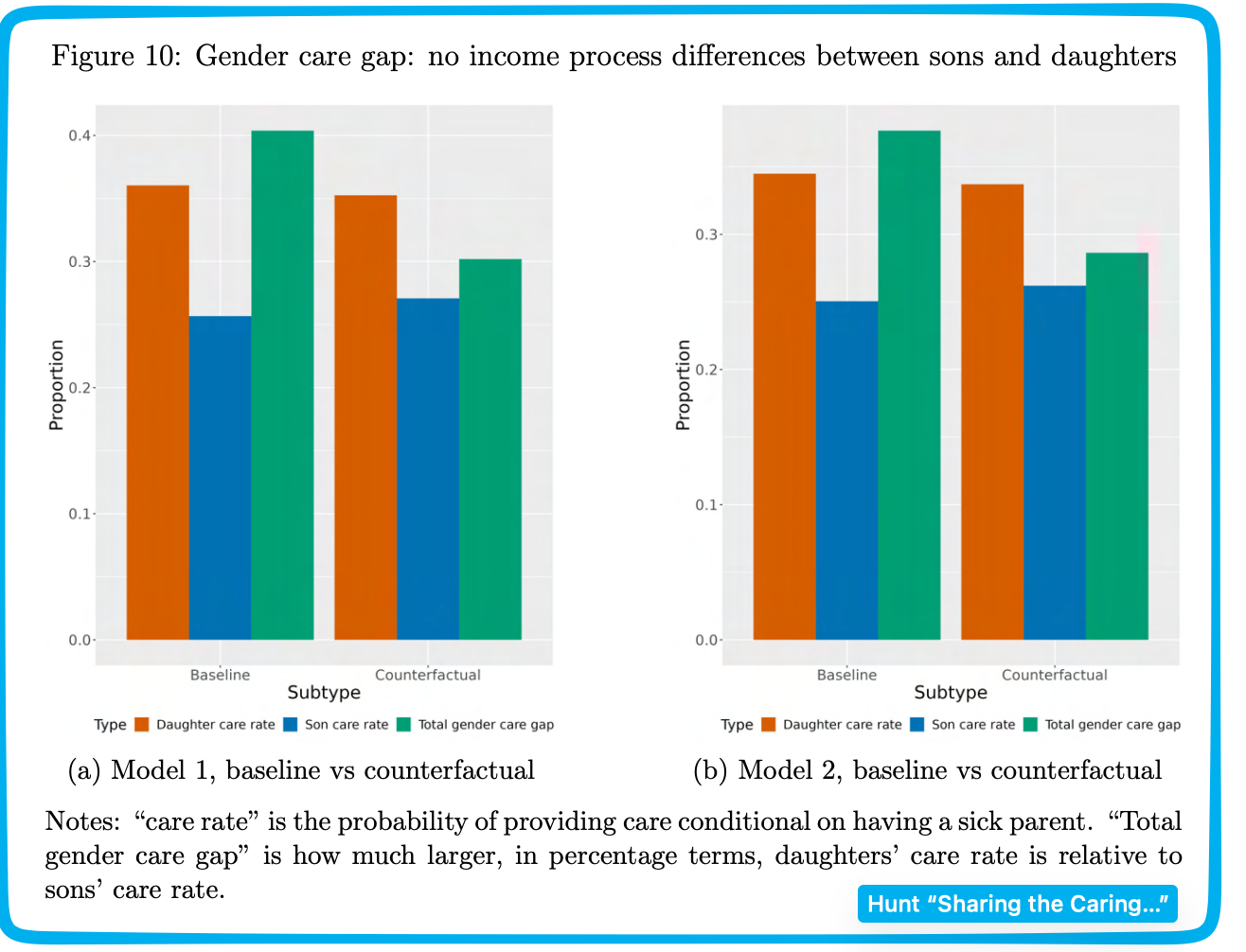
Explaining the eldercare gender gap, researchers also looked at education (more educated, more care), and whether the care was for a mom or a dad (daughters did more for mothers). In addition, proximity mattered, as did the severity of the health shock. And, the research assumed a 2-sibling family with age 81 as the median for a parental health shock. With data from 35,105 unique respondents, their data came from the U.S. Health and Retirement Study, 1998-2018.
Our Bottom Line: Free Riders
When a mom or a dad has a health shock, the adult female child will likely do more of the care. Experiencing less of the cost (defined economically as sacrifice) while enjoying the benefit, her brother could be called a free rider. Defined as the act of letting one individual or a group pay the cost while others share the benefit, free riding is everywhere. We have seen it in restaurants when diners equally share a bill. We see it with the tragedy of the commons when individuals abuse community-controlled air and land. And yes, there are free riders at school, at work, and at home.
My sources and more: Ranging from Timothy Hunt at the University of Oxford to the AARP, there is considerable research on eldercare.