What Spare Parts Say About Capitalism
October 27, 2026
Going out to dinner with friends, we probably will have two problems.
One occurs before the meal and the other after it.
With both, we could have a free rider.
Diners’ Dilemmas
Before the Meal
During an evening with friends at an upscale restaurant, the menu arrives and you have to choose between a pricey lobster with several glasses of Champagne or an inexpensive pasta dish and the house wine. You know that the check will be divided equally.
Here, we are dealing with what economists have called the “unscrupulous diner.” Knowing the cost of their more expensive meal will be divided among everyone, one person succumbs to the lure of reducing their extra amount ( a marginal decision) and ordering the lobster and Champagne.
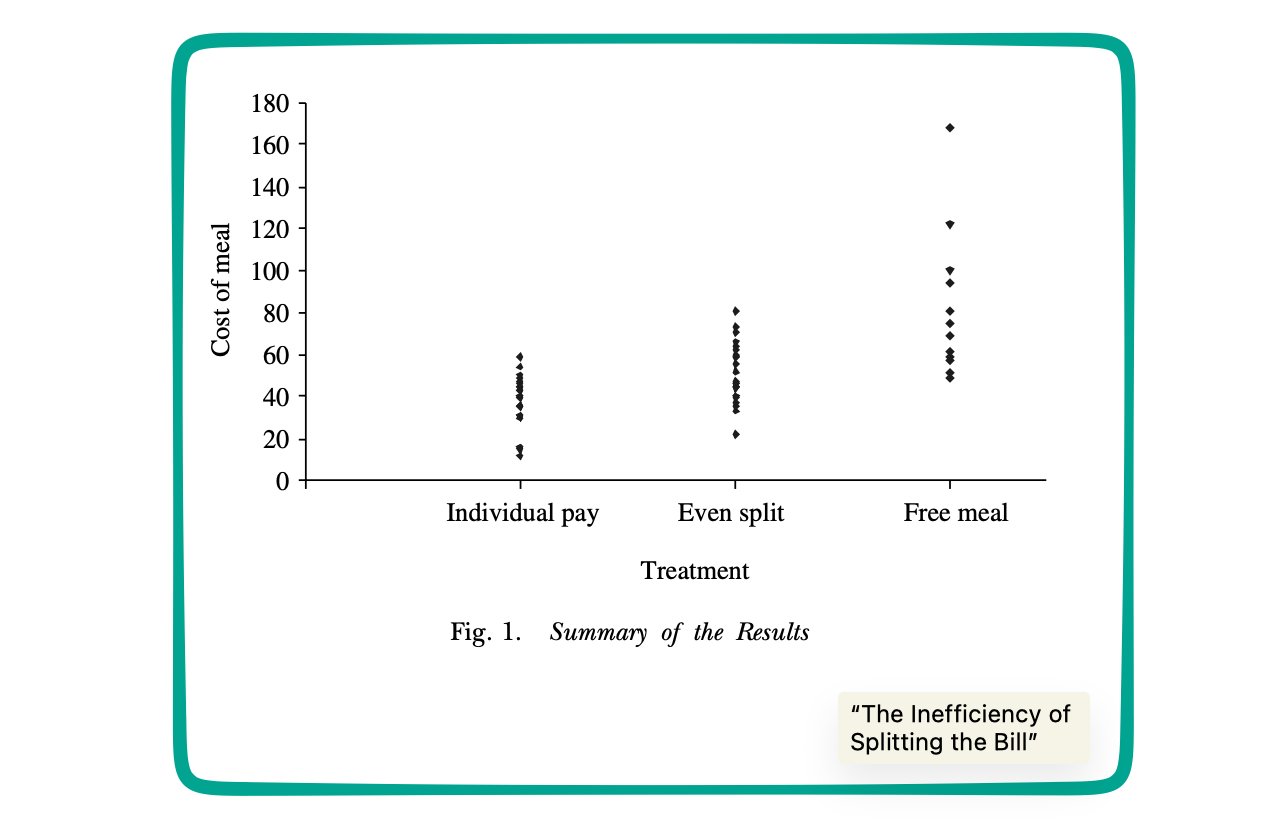
In a classic experiment where hypothetical diners had three alternatives, researchers compared diners’ decisions and the cost of the meal. You can see below that it was cheapest when individuals paid and more expensive with the even split (because of the “unscrupulous diners”):
After the Meal
To make it easier for a gracious professional waiter, you decide to pay with one credit card. Afterwards, you split the check equally, and separately promise to repay the person who covered the bill
In a recent article, the Wall Street Journal told us that Gen Z “is twice as likely as millennials to have one person front the tab. But then, based on the Zelle Avoidance Economy Report, 20% say it is not unusual to wait a month to get repaid. One reason could be “mental accounting.” The person who owes the money perceives a future debt that is easier to avoid.
More precisely, 76% of Gen Z consumers who absorb the price of a trip or event are never fully repaid. Among the participants in the Zelle survey, only 28% said they paid someone back immediately. Meanwhile, 18% said they took up to one month, 10% said two to six months, and a whopping 11% say they can take longer than six months.
Our Bottom Line: Free Riders
Both the unscrupulous diner and the friends that avoid the tab are free riders. Defined as the act of letting a group pay the cost of your behavior, free riding is everywhere. We have seen it with the Tragedy of the Commons when individuals abuse community-controlled air and land. In class and at work, free riders let the group do the work and then enjoy the high grade or positive evaluation.
My sources and more: Thanks to WSJ for inspiring today’s post. From there, Zelle research had helpful stats. And finally, we reread the classic 2004 Splitting the bill paper.