![econlifelogotrademarkedwebsitelogo[1]](/wp-content/uploads/2024/05/econlifelogotrademarkedwebsitelogo1.png#100878)


Our Weekly Economic News Roundup: From Diesel to Helium
September 19, 2026
Like me, gas leaf blowers might really annoy you. At more than 100 decibels, their noise pollution equals a jet engine at takeoff. As for emissions, blowers and other lawn equipment engines annually produce the fine particulates that can equal 234 million cars.
Perhaps now though, pricey crude will solve our gas-powered leaf blower problem.
The Leaf Blower Problem
Our story starts in California during the 1980s. Concerned that hosing down their driveways drank too much water, people used a new device. Originally for crop dusting, the device could also be a back-mounted “clean-up machine” that removed leaves and debris from your lawn.
You can see how easy it was to do a clean-up:
For lawn maintenance firms, the gas-powered leaf blower was a time-saving money maker. Because it multiplied the number of lawns they could maintain, the leaf blower elevated incomes and lowered prices.
But it did have a downside.
Regulation
During 2017, Maplewood, NJ proclaimed a gas leaf blower ban on all Sundays and from May 15 to September 30. They also limited when residents could use them throughout the year. Their reason? Pollution and noise,
Responding, the New Jersey Landscape Contractors Association and nine private landscapers took the town of Maplewood to court. Saying the ordinance harms their businesses and creates inefficiencies, they lost the case.
From there, the number of bans has accelerated. A leader, California prohibits the sale of new gas-powered small off-road engines. Meanwhile, Miami Beach, Florida, and Washington D.C. also outlawed gas leaf blowers, as have hundreds of smaller municipalities (but not mine!).
Our Bottom Line: The Tradeoff
As economists, we know that every decision has an opportunity cost. Consequently, whatever we choose will include its benefits and force us to forgo the benefits of the alternative.
With gas leaf blowers, the benefits include being ideal for heavy wet leaves, having long runtime (until the tank runs dry), and requiring no new investment. Meanwhile, electric leaf blowers are relatively quiet with no on-site emissions and, during use, low upkeep. However, they will require an investment in new equipment for most firms.
A tradeoff:
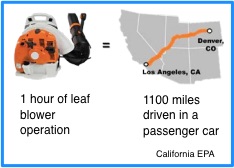
My hope, though, is that rising gas prices will nudge lawn maintenance firms in the right direction. Seeing electric blowers finally can make sense, lawn maintenance firms hopefully will switch. They will see that expensive gas, currently averaging $4.48 a gallon, lowers their opportunity cost.
My sources and more: Thanks to Axios for inspiring where we began with today’s post. From there, looking for less boring and unpredictable gasoline price stories, we wound up at leaf blowers and The Regulatory Review. In addition, this 99% Invisible podcast provides a pleasant way to ponder leaf blowers.