![econlifelogotrademarkedwebsitelogo[1]](/wp-content/uploads/2024/05/econlifelogotrademarkedwebsitelogo1.png#100878)


Our Weekly Economic News Roundup: From Drive-Throughs to Blockbusters
August 8, 2026
Do We Have a FOMO or FEMO S&P 500 Bull Market?
August 10, 2026
At Stanford University, AI is helping students find love–or at least the right date. Called Date Drop, the algorithm asks 66 questions that focus on politics, values, and lifestyle. Survey participants hope to find people like them.
And that might be the problem.
Date Drop
Created by a Stanford grad student as a student project, the survey spread to 11 schools. Many of the 5,000 or so students that have used it say they are having a good time. It’s fun, they say, to answer the questions and then anticipate its Tuesday night 9 p.m. results “drop.”
The app includes questions about having kids, being a morning or night person, and spending habits. Respondents tell if they would rather cheat or fail an exam. In addition, when friends “couple” two people, the odds climb that they will become a match.
Explaining its value, one of Date Drop’s developers said it’s the “best dating pool that I will ever be a part of.”
An economist would say the pool represents assortative dating.
Our Bottom Line: Assortative Dating
In a traditional marriage, the husband brings home the bacon and the wife cooks it. Or, as an economist might say, the traditional family has a market specialist and a domestic specialist. Rather like a factory, household output includes children, meals, and clean dishes.
Alternatively, we could have what economists Justin Wolfers and Betsey Stevenson called consumption complementarities. These couples no longer require market and domestic specialists. With day care, take-out, and dishwashers, and both partners earning income and both (or none) cooking, we have a new economic unit. Consequently, domestic pairs with the same education, religion, and credit card scores are about companionship more than children. Instead of production complementarities, they have consumption complementarities.
As you might expect, those consumption complementarities tend to sort us.
However, when we look at the academic studies, it becomes more complicated.
Some researchers have concluded that homogamy has become less likely. While there was an increase in the educational resemblance of spouses from 1960 to 2003, more recently, they observed no rise in educational homogamy. One cause could be the varied marriage markets that later mating and online dating create.
I added the blue rectangle surrounding recent results:
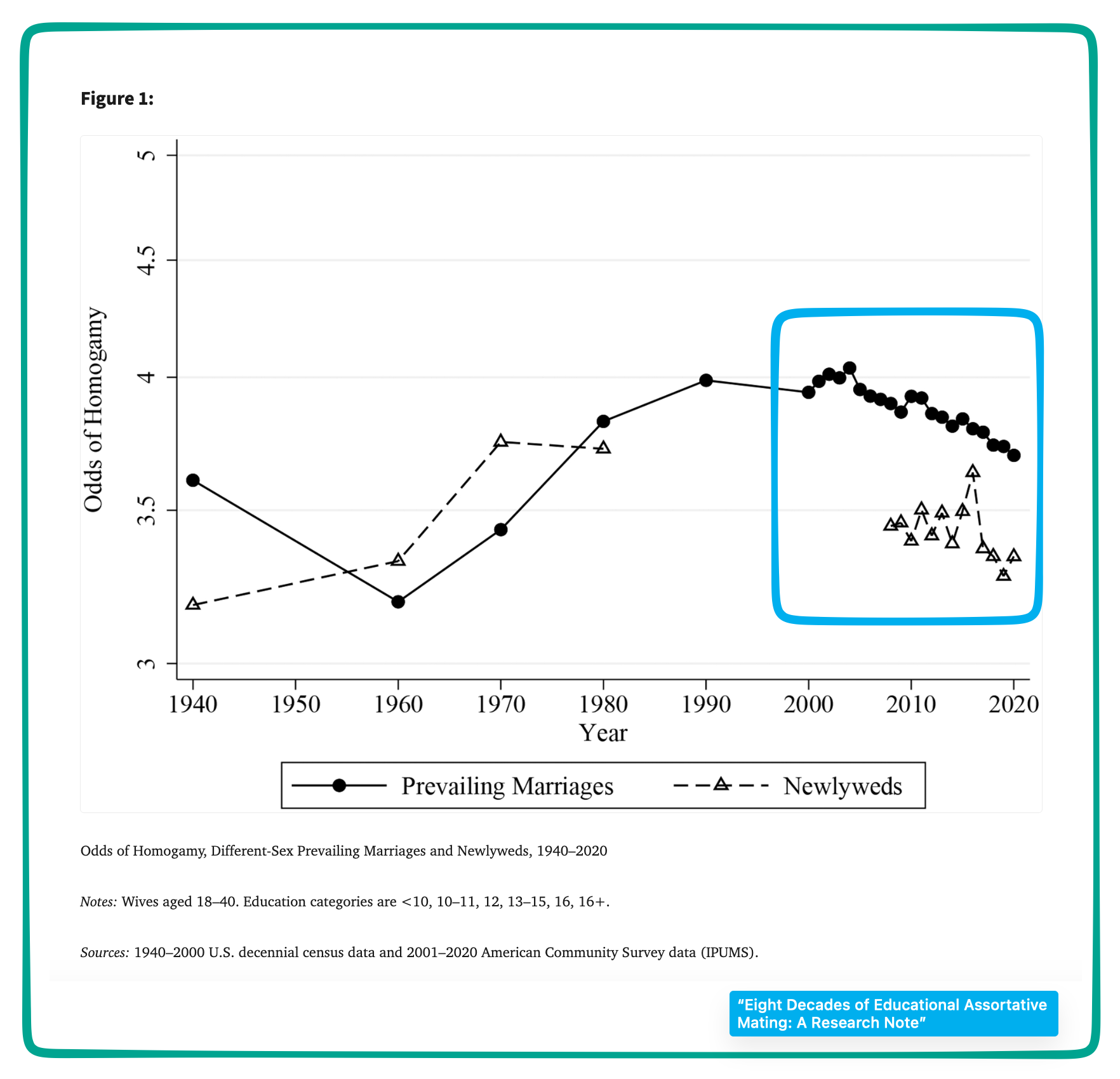
Further muddying our conclusions, two recent papers suggest that increased assortative mating exacerbated income inequality. They did note that marriage can be an equalizing income phenomenon when resources are pooled. However, they also saw that because assortative mating was based on personal wealth, in affluent households, the most successful breadwinner oversaw finances. Propelling them to the top, the financial decision-making for these high-net-worth couples contributed to wealth inequality.
So, although the academics are a bit messy, we can hypothesize that assortative marriage markets contribute to income inequality. And, as an assortative facilitator, Date Drop fuels the phenomenon.
My sources and more: It’s always fun when disparate resources converge. Today, it was WSJ, here and here, and these papers, here, here, and here.
Please note that several of today’s sentences were in a past econlife post.