![econlifelogotrademarkedwebsitelogo[1]](/wp-content/uploads/2024/05/econlifelogotrademarkedwebsitelogo1.png#100878)

How Humanoid Robots Affect Labor Markets
July 19, 2026
How Fuel Affects the Shipping Cost of Our Imports
July 21, 2026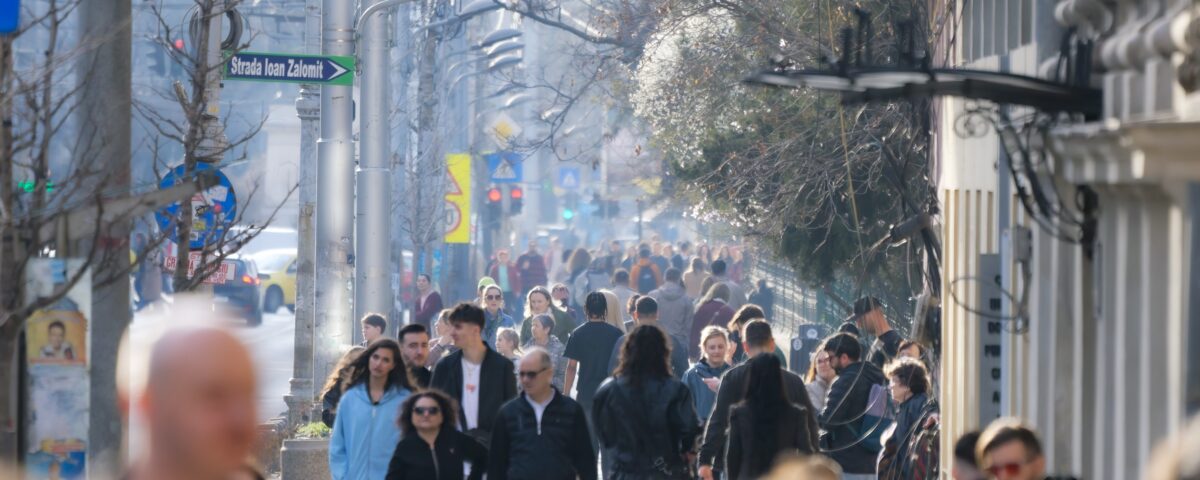
Studying pedestrian habits, an applied physicist at the University of Navarra noticed that individuals spontaneously drift leftward. Pivoting from his original research, he (and his associates) looked more closely at their random discovery.
Our tendency toward counterclockwise movement takes us far beyond our walking patterns.
Counterclockwise Bias
Walking down a street in Manhattan, you (like I) probably group with others that move in the same direction. Similarly, we tend toward the zipper effect when moving through a narrow doorway (or a traffic bottleneck) by forming two alternating streams rather than a single line. Both illustrate optimal crowd movement. Called spontaneous order by economists, crowds move in a collective pattern.
Now though, rather than the crowd, a recent study concluded that our collective action might have originated with each of us, individually. As the researchers tell us, “…collective CCW motion is rooted in inherent individual tendencies.” (CCW=counterclockwise)
The study started when Dr. Echeverría-Huarte had been observing whether we tend to maintain a certain distance from other people while walking when he noticed that most of us “spontaneously veer to the left.” Given the choice, we select the counterclockwise option. Wondering why, he redirected his research. Now, after five years, he eliminated a slew of hypotheses. Asked to meander around a courtyard, a drone recorded that 80% of the people moved counterclockwise. Righthanded and lefthanded individuals veer leftward. Shone by children in a Japanese kindergarten and also by adults, age did not matter. Comparing Japan and Spain, they concluded that neither a home country nor a culture generated our leftward drift.
In fact, why we have a leftward bias remains a mystery. But knowing it exists can make a difference.
Store design
Supermarket layout designers have always known our CCW tendencies.
Hearing that supermarkets guide shoppers to move counterclockwise through the store, I asked ChatGPT to draw a graphic with one possible design:
 Moving from the fruits and vegetables that occupy the far right end of the store, we have to move counterclockwise next. That takes us to the dairy along the back of the store and the aisles we could visit. Analysts point out that while the direction of our loop matters, what we pass along our CCW loop is even more important. In addition, shoppers familiar with the store might ignore CCW “markers.”
Our Bottom Line: Wayfinders
Businesses optimize their land, labor, and capital though the wayfinders that enable us to…yes… find our way.
Hired by the people who design airports, hospitals, museums–any place we have to navigate–wayfinders use architecture, signage, lighting, and color to take us from the entrance to the elevator, from Terminal A to Terminal D, from the produce to the dairy. Through floor panels, counter shapes, signs, and signals that we rarely notice, they nudge us toward our destination.
Like behavioral economics, wayfinding is at the intersection of psychology and economics. To give us the nudges we need to get where we are going, wayfinders have to understand how we think. And now, for optimal productivity, they need to know about our leftward bias.
My sources and more: Nature Communications and others, including Smithsonian Magazine, the NY Times, and the University of Navarra, described our countercockwise bias. It all reminded me of wayfinding and past articles in the NY Times and WSJ. But, as always, the best place to go for design insight is 99% Invisible.
Please note that several of today’s sentences about wayfinders were in a past econlife post.