![econlifelogotrademarkedwebsitelogo[1]](/wp-content/uploads/2024/05/econlifelogotrademarkedwebsitelogo1.png#100878)


What Oscar Winner Wagers Predict
March 15, 2026
At What Gasoline Price Do Our Car Preferences Shift?
March 17, 2026
While urea fertilizes the largest farms, it also is in those tiny packets that preserve our flower deliveries.
Urea Production and Prices
Production
If we went 100% organic and stopped using fertilizer, only an estimated 4 billion of the world’s 8.2 billion (or so) people could be fed.
So, with approximately 45% of the world’s tradable urea fertilizer coming from the Middle East, it matters that the Iran War prevents urea from moving through the Strait of Hormuz.
(Oversimplifying) urea production starts with nitrogen and natural gas. Combined, they create ammonia that (with CO2) becomes granular Urea through another chemical conversion. Because it’s expensive to transport natural gas, urea plants need to be located near a natural gas supply. And for that reason, one ideal place is the Persian Gulf. Then in granular form, the urea can easily be shipped.
Preferring minimal storage (and avoiding pricing risks), producers ship urea on demand. As a result, their demand peaks during the springtime for U.S. and European and flips for Brazil and India.
Prices
Fertilizer, at 20% to 30% the cost of crop production, can determine farmers’ profits. Creating the “perfect storm” for soaring urea prices, China has banned its exports, Russian exports are sanctioned, and natural gas production was down in Europe because Russia attacked Ukraine. To all of that we can add the urea that no longer passes through the Strait of Hormuz.
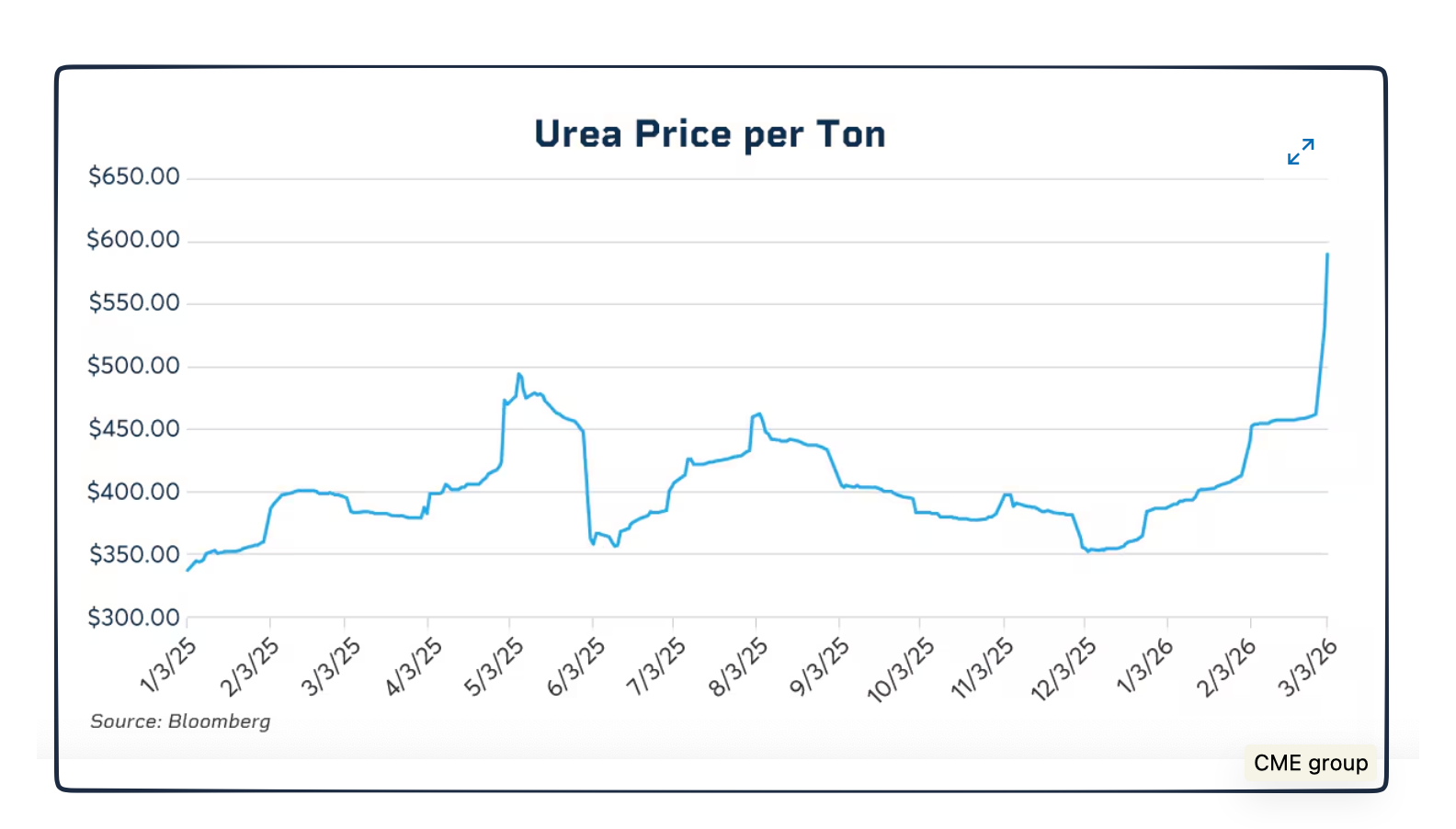
After Russia invaded Ukraine, urea prices peaked at $1,100 a metric ton. However, during 2024, they plunged to $300 a metric ton.
Now, close too $600, urea prices are again spiking:
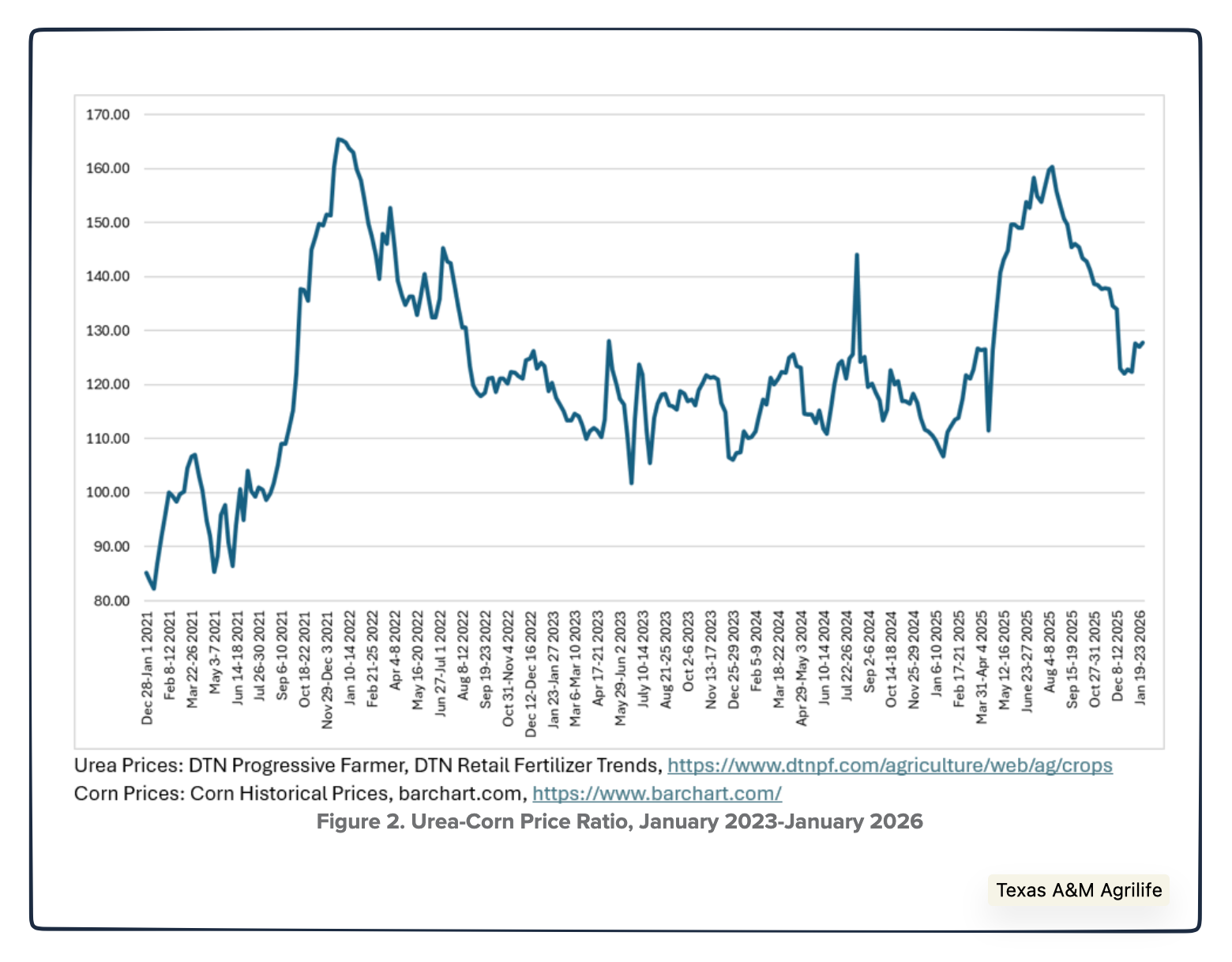
To judge urea prices, the urea to corn ratio is a handy metric. Currently close to 124, the ratio might be heading for a high with lower corn prices and soaring urea:
Our Bottom Line: Supply Side Shocks
The Bloomberg’s Odd Lots podcast tells us that the Iran War created a fertilizer supply shock. Defined as an unexpected external hit to the production side of a market, a supply shock shifts the supply curve to the left. As a result, quantity sinks and prices rise.
Close to spring planting season, the timing of the Iran War exacerbated the urea supply shock as did the Russian sanctions and China’s export ban. Then, furthermore, U.S. farmers’ alternatives are not ideal. They could use less. They can switch from corn, for example to soybeans but tariffs created problems there. Or they could use a different nitrogen product.
In large farms and tiny packets, urea is one of those little-known commodities that affect us everywhere.
My sources and more: Again, the Odd Lots podcast was my inspiration. Then, we found more detail at Texas A&M agrilife extension and from CME group.