![econlifelogotrademarkedwebsitelogo[1]](/wp-content/uploads/2024/05/econlifelogotrademarkedwebsitelogo1.png#100878)


Why It’s Tough to Allocate Water
May 17, 2026
How Harvard Could Cure Grade Inflation
May 19, 2026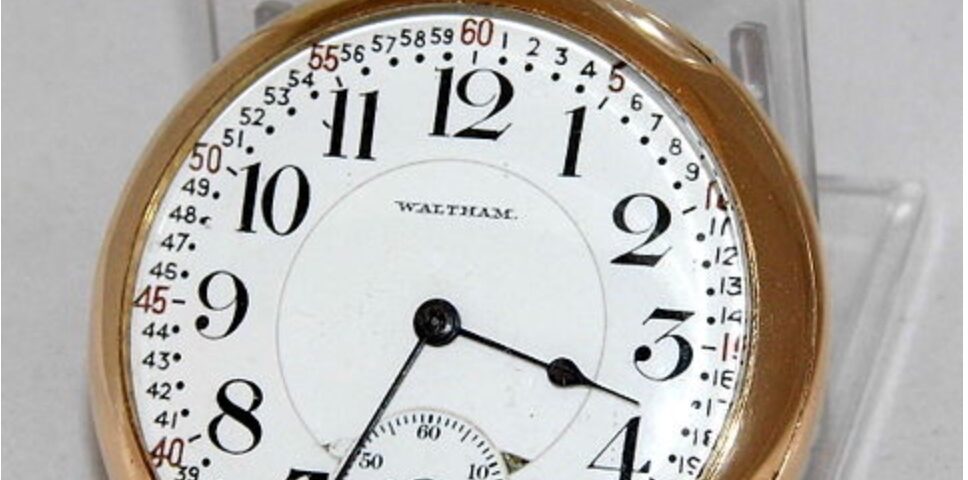
Watches are not only about telling time.
Wristwatch History
Armies
During wartime, the military requires synchronization.
Fighting the Second Boer War in 1900 or so, soldiers “jerry-rigged pocket watches and strapped them on their wrists.” (Especially if you were holding a rifle, it was impractical to reach into your pocket to check the time.)
Fast forwarding to World War I, the wristwatch starts to take off as does a small company called Wilsdorf and Davis. However, the watches they made needed a name so, as they explained, like Kodak, they made up one and called it the Rolex.
A journalist described a World War 1 battle that depended on the time:
“The watch hands [on the officers’ wrists] pointed to the second which had been given for the assault to begin, and instantly, to the tick, the guns lifted and made a curtain of fire round the Chateau of Hooge, beyond the Menin road, six hundred yards away.”
Navies
Navies also required “portable time.” They needed their watches for precisely calculating longitude. As a result, the British government offered a prize that, in today’s money, would have been close to 2 million dollars. Responding in 1735, John Harrison invented a marine chronometer that let them know the spread between local time and Greenwich Mean Time. Each one hour equaled 15 degrees of longitude.
Railroads
During most of the 19th century, different towns and cities and villages–anyone–could decide the time. You can imagine how tough it was to create a train schedule. I assume that passengers could have a 10:30 arrival time at one destination and 10:15 for the next one.
But then, in 1883, the railroads decided to tell us what time it was. They drew four (sort of) vertical lines. While state boundaries did not matter, economic connections did. When it was 11 am in the East, it would be 8 am in the West. Established by the train schedules, everyone knew what time it was supposed to be.
As a result, on Sunday, November 18, 1883, clocks, watches and schedules across the U.S. adjusted to reflect the standardized time. On the Baltimore and Ohio Railroad Line, all conductors were told to move their watches back 28 minutes.
So yes, they needed watches. While at first it was pocket watches, after World War I, companies manufactured railroad wristwatches that met higher accuracy and durability standards.
Our Bottom Line: Private and Social Return
Long ago, Edwin Mansfield (1930-1997), a University of Pennsylvania economist, said that a seemingly small innovation can have a large impact through its private and social return. Although he was referring to manufacturing inputs like thread, he could easily have been talking about the wristwatch. Its private return, as profit, initially went to watchmakers like Rolex. Next, a larger second phenomenon kicks in. Rippling across millions of individuals, a social return creates the positive externalities that bring benefits to countless individuals.
With the wristwatch, about more than time, those externalities related to winning wars, navigating ships, and synchronizing railroads.
My sources and more: The idea for today’s wristwatch history began with yesterday’s walk. Listening to the Acquired 5 hour podcast on Rolex I learned the entire story of a watch brand and much more. Then, wanting to see where the wristwatch went, I went to the Atlantic and the Rolex website. And finally, economic historian David Landes’s (1924-2013) Revolution in Time is a classic. (Before the watch, Landes told us that some 15th century soldiers brought a rooster for a wakeup call.)
Our featured image is from UnconstrainedTime. Also please note that several of today’s sentences were in past econlife posts.