![econlifelogotrademarkedwebsitelogo[1]](/wp-content/uploads/2024/05/econlifelogotrademarkedwebsitelogo1.png#100878)


Why Are Consumers Depressed?
December 1, 2025
How Much We Work
December 3, 2025
In addition to running 31 miles, a recent Washington D.C. ultramarathon required runners to have eaten an item off the menu and a drink at nine Taco Bells.
But there is more.
The Taco Bell Ultramarathon
Race rules stated that no later than the fourth stop, runners had to have downed a Chalupa Supreme (340 calories) or a Crunch Wrap Supreme (530 calories), and, by the eighth, a Burrito Supreme (390 calories) or Nachos Bell Grande (740 calories). The time cap was 11 hours and receipts were requested.
Starting at 8 a.m., runners nibbled (or gobbled) their first taco as they started the race. A five mile jog took them to the next Taco Bell. Some planned to walk and eat. Others were seasoned marathoners. One said he especially worried about the fiber. Another runner used the soft taco strategy. A third person filled his running flask with Pepsi. Asked how they felt as the race progressed, most said, “pretty bad” or just “meh.”
By race day, close to 1,000 runners had signed up.
The winning time was 4 hours, 12 minutes, and 35 seconds. 429 people finished.
Our Bottom Line: Reference Point Dependency
University of Michigan (and my favorite) economist, Justin Wolfers explained the economics of marathons in a 2014 NY Times Upshot column. Finishers say the experience is torture–but worth it. In an NBER paper, four researchers let us relate the grueling challenge of the marathon to the cost benefit tradeoffs we all weigh when deciding how hard to push.
Making the decision during a marathon, many already know the finish time reference points that become their goals:
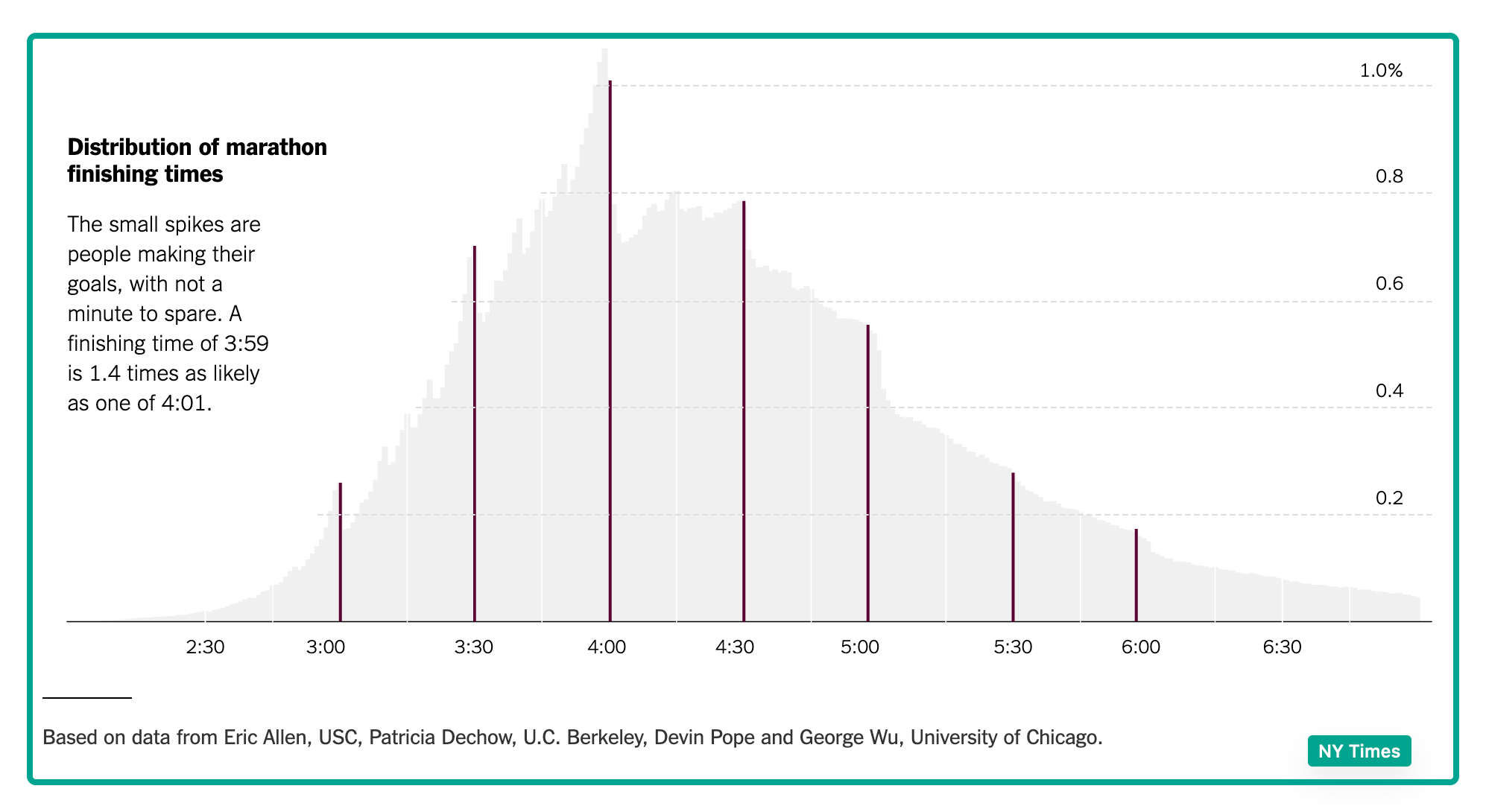
Dr. Wolfers points out that goals work as good and bad motivators. For that reason, displaying “reference dependent” behavior marathon runners cluster near the 3, 4, and 5 hour marks. However, at that point, he cites the difference between 2:59 and 3:01 or 4:59 and 5:01. The latter times, for many of us, signal failure. Elsewhere too, we establish the markers we will use to measure success or failure and then the cost we are willing to sacrifice to get there.
He warns in his conclusion to be wary of the reference point dependency that makes us miserable. Perhaps most crucially, he suggests that sometimes when selling a house or investing, we should be willing to accept less than our reference point goal when its cost is too high.
I suspect that the Taco Bell runners had flexible reference points.
My sources and more: Thanks to Bloomberg radio for alerting me to the Taco Bell ultramarathon. From there, I located more details in The Washington Post. Then, this Justin Wolfers column provided the insight as did this NBER paper that focused on reference dependent behavior.