![econlifelogotrademarkedwebsitelogo[1]](/wp-content/uploads/2024/05/econlifelogotrademarkedwebsitelogo1.png#100878)


What We Can Learn From a Pork Cutlet
August 18, 2026
Back to Starbucks, Back to Our Brains
August 20, 2026
GM and Ford both claim to be “the most American automaker.”
Let’s take a look.
American-Made Autos
It can be tough to guess an “American-made” auto because most are manufactured by companies based in the Netherlands, Japan, and South Korea:
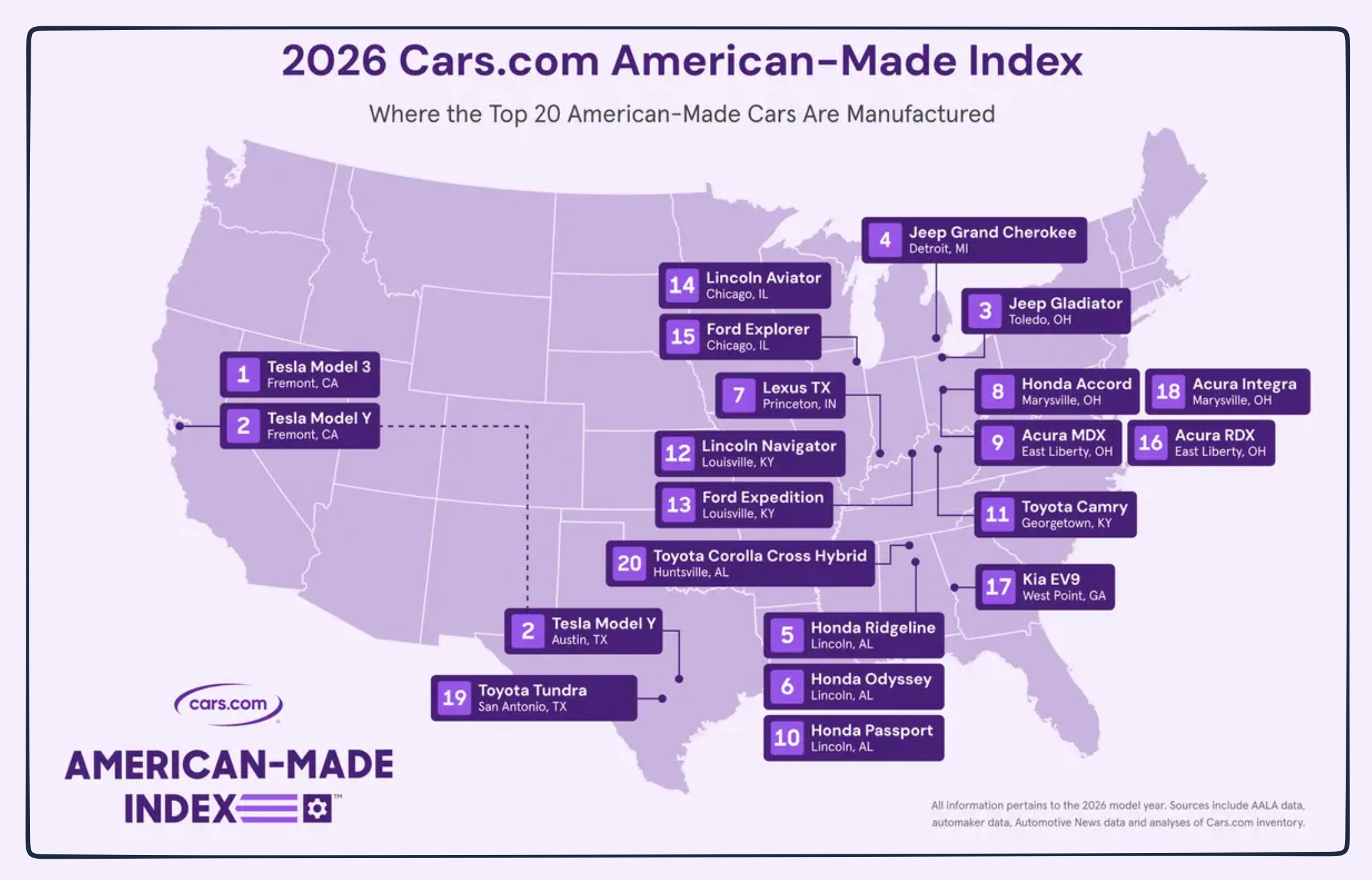
To make its list of 86 American-made vehicles, Cars.com began with 400. The number is down from last year because carmakers discontinued many of their pricey electric vehicles. Texas-based Tesla, for example, eliminated its Model S and gullwing doored Model X SUV–two models that had been at the top of past lists. Similarly, Volkswagen’s ID.4 is gone from the top 10.
At the same time, reflecting new supply chains, the remaining vehicles have a higher proportion of domestically sourced parts. Jeep Grand Cherokee jumped to #4 and the Lexus TX 350, to #7 because of much more American content. The Lexus rose by 34 spots because of entirely U.S. made engines and transmissions.
Including neither Ford nor GM, these are the top eight:
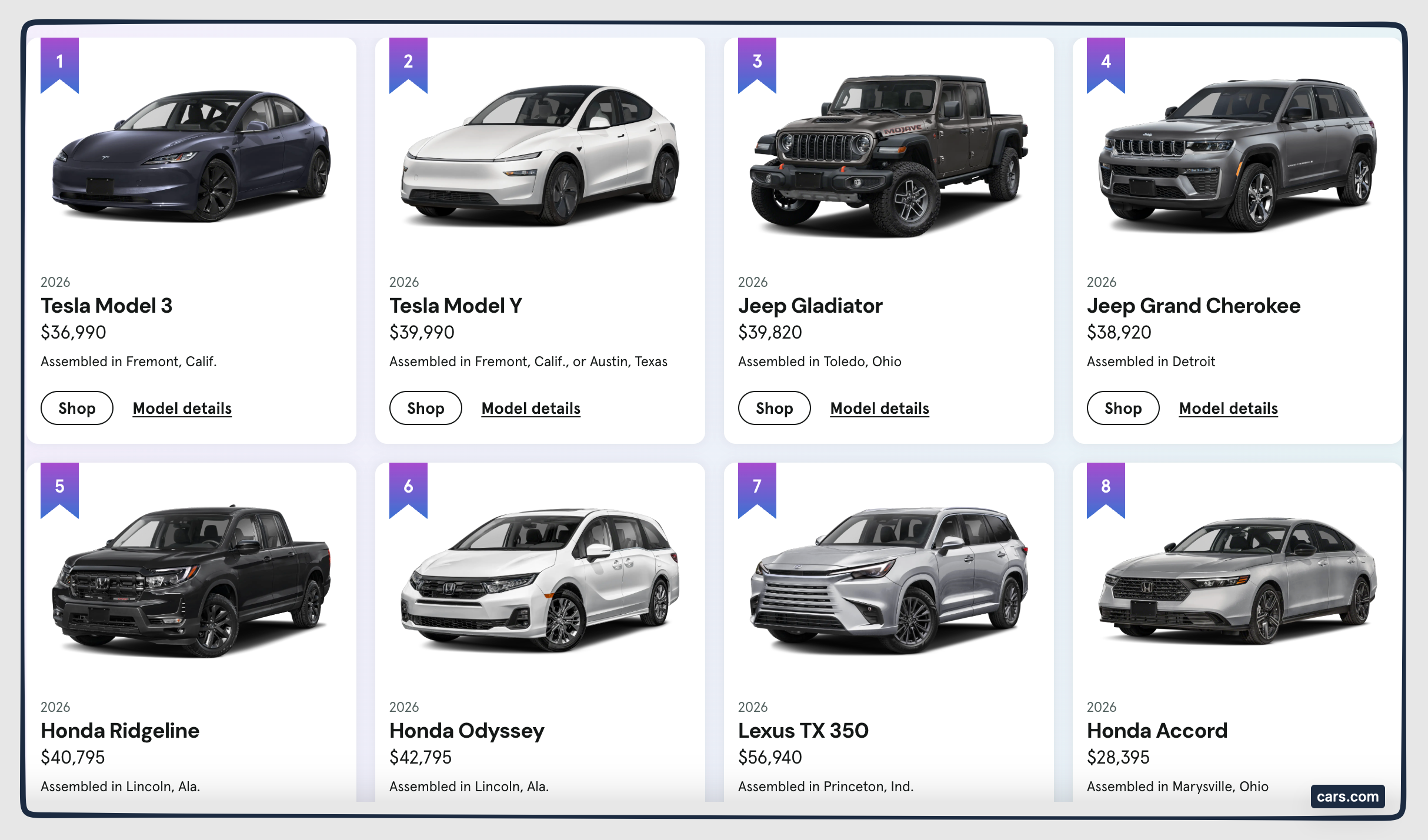
To qualify as American Made by Cars.com, vehicles like the Honda Ridgeline (#5), Odyssey (#6), and Accord (#8) had to have satisfied five criteria:
- Location(s) of final assembly (of the light-duty vehicles that compose the Index)
- Percentage of U.S. and Canadian parts
- Countries of origin for all available engines
- Countries of origin for all available transmissions
- U.S. manufacturing workforce
Meanwhile, Mexico is the final stop for Ford’s Bronco Sport, Maverick, and Mustang Mach-E. Similarly, GM’s Chevrolets are assembled in Mexico (Blazer and Equinox), Canada (Silverado), and South Korea (Trailblazer and Trax).
Our Bottom Line: Comparative Advantage
We can assume that emphasizing “American-made” would have made David Ricardo (1772-1823) rather unhappy.
As the economist who first explained comparative advantage, David Ricardo said each nation should make the goods and services for which it has the lower opportunity cost and import what it does not produce. Because of those imports, consumers would enjoy lower prices and more variety. Benefiting also, exporters have larger markets that support the efficiencies of economies of scale.
By emphasizing “American Made,” the U.S. will be less able to enjoy the fruits of comparative advantage.
My sources and more: Thanks to yesterday’s WSJ for reminding me it was time to return to “Made-in-the-USA.” Then, we looked at our American-made post and, of course, Cars,com for its Index.
Please note that several of today’s sentences were in a past econlife post.