![econlifelogotrademarkedwebsitelogo[1]](/wp-content/uploads/2024/05/econlifelogotrademarkedwebsitelogo1.png#100878)


How To Fight a Weight Loss War
June 7, 2026
What Does SpaceX Get Paid For?
June 9, 2026
European North/South stereotypes have been predictable. The North is dour but hardworking while Southerners are “drinkers and dreamers.” In the European Union, the Germans and Dutch have complained about southern “Club Med” countries. The German media even condescendingly said, “Greece, but also Spain and Portugal have to understand that hard work—meaning ironfisted money-saving—comes before the siesta…”
Now though, Spain is surprising everyone.
Spain’s Surprising Success
With 27% unemployment and banks needing bailouts, Spain especially suffered from the 2008 financial crisis. Then, before they had entirely recovered, Covid hit. But soon after, with their welfare state extending its safety net and tourism growing, the economy had more demand than its labor force and aging population could satisfy.
They needed immigrants.
Offering incentives, especially to attract Latin Americans that knew the language and were culturally similar, Spain welcomed three million immigrants between 2021 and 2023. As workers, the newcomers filled the empty job positions. As consumers they spent money. And, as a group, they stimulated the economy.
At the same time, Spain had hiked the minimum wage, initiated energy price controls, and offered a guaranteed income for the least affluent. They also wound up creating one third of the EU’s new jobs. Most notably, though, their disposable income grew three times as much as France’s and exceeded Germany’s by a whopping multiple of eight. Unemployment, poverty, and inequality were all down. In 2024, the Economist said Spain had the world’s best economy.
It was win/win until the housing shortage developed.
Our Bottom Line: Human Capital
Migrants brought their human capital to Spain. They brought the education, informal knowhow, and psychological equipment that compose our human capital.
Reflecting human capital, Spain has demonstrated higher value job growth in sectors Including information technology and finance:
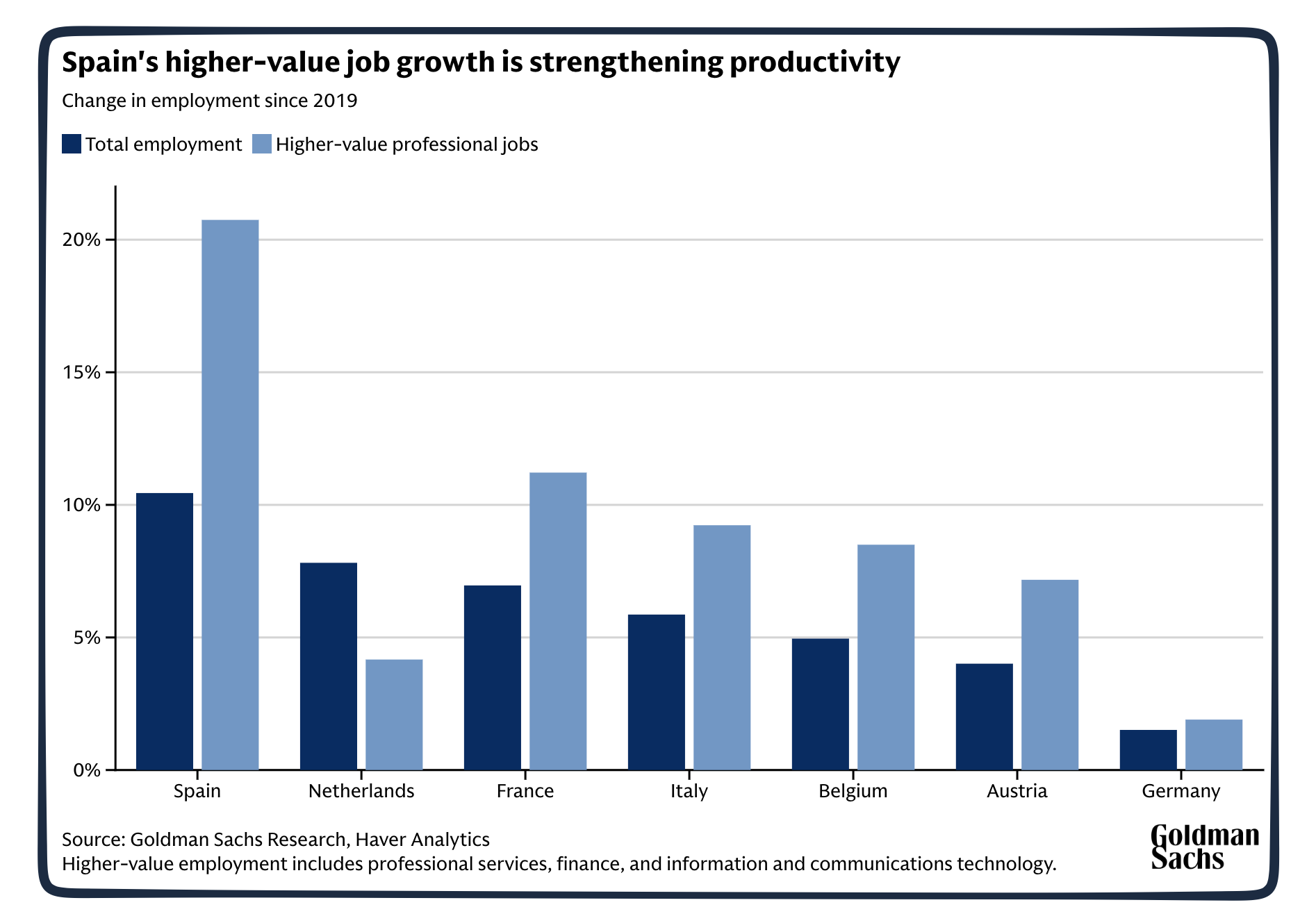
According to an IMF economist, a 1% increase in migrants’ share of the adult population in a rich country propels the GDP to an extra 2% of growth. At three million, migrants’ share of Spain’s population could have been close to 6%. Consequently, we can hypothesize that immigration did indeed invigorate Spain’s economy.
My sources and more: Thanks to Slate Money for alerting me to The Atlantic’s “The Spanish Exception”. Because of its focus on immigration, from there we returned to this econlife. Then, we discovered this Goldman Sachs commentary that confirmed all we concluded about Spain. Related, an Economist spotlight on Portugal also displayed the rising importance of the European South. It returns us to a contradiction of the stereotypes we initially cited.
Please note that several of today’s sentences were in a past econlife post.