![econlifelogotrademarkedwebsitelogo[1]](/wp-content/uploads/2024/05/econlifelogotrademarkedwebsitelogo1.png#100878)


Why We Should Worry About the Cables in the Strait of Hormuz
June 3, 2026
Where Is the Worst Waste Generation?
June 5, 2026
Tariffs have affected musical instruments.
But not as policy makers expected.
Musical Instrument Tariffs
Musical instrument tariffs came close to tripling from the end of 2024 to a 2026 level of 16.6%. But demonstrating the uneven landscape, pianos, violins, and horns were among the hardest hit:
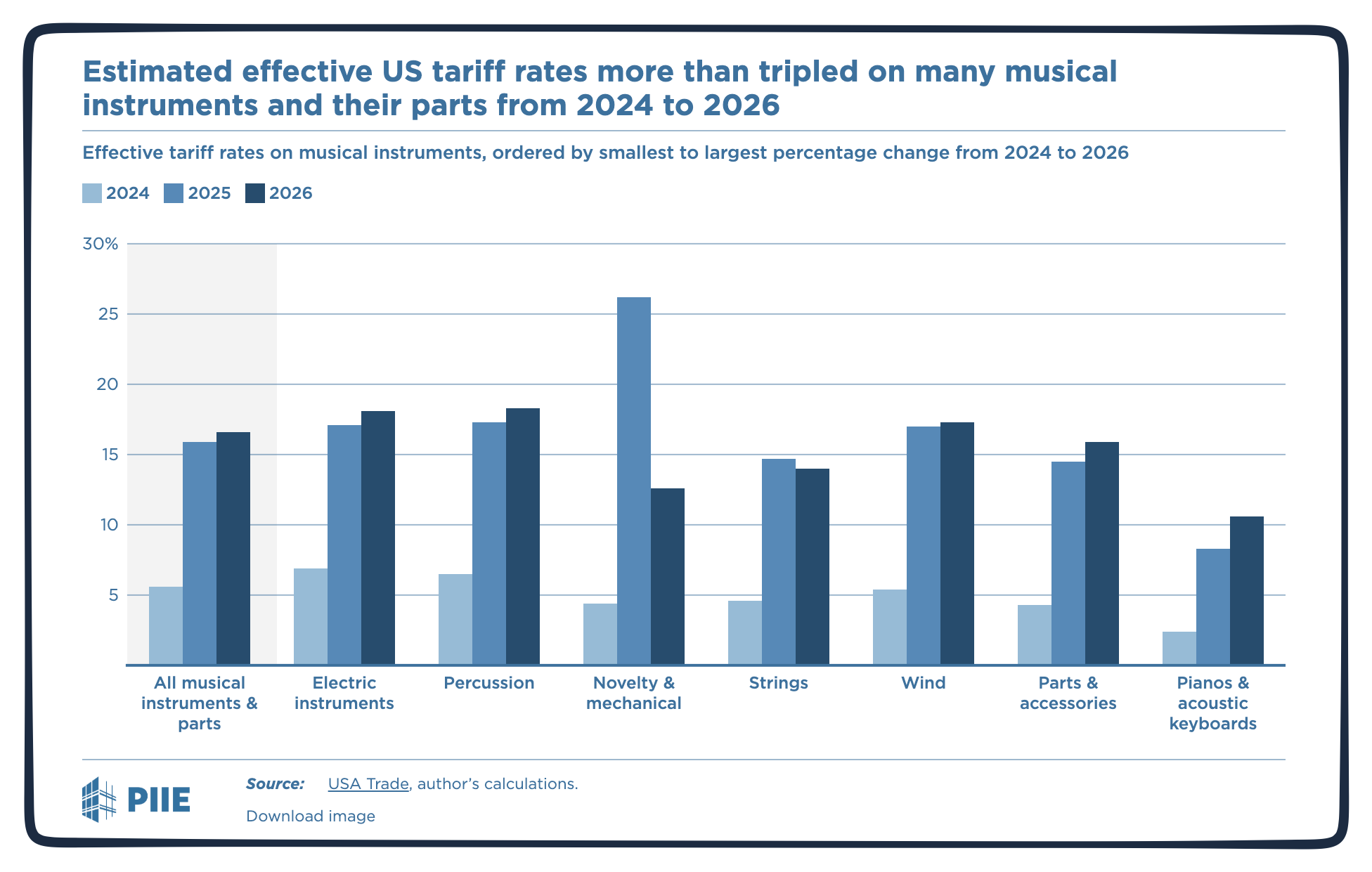
Nudging musical instrument Import levels down by slightly more than 20% between the end of 2024 and the first quarter of 2026, the tariffs did precisely what they were supposed to do.
But not quite.
Tariffs impacted our higher quality professional instruments from Europe, Japan, and South Korea less than the lower quality imports from China. Chinese tariffs were the primary reason for the 70% plunge in orchestral wind instruments.
Less from China was supposed to mean more domestic production.
Instead, we wound up with a cascade of unintended consequences.
Our Bottom Line: Unintended Consequences
Demand
PIIE (Peterson Institute for International Economics) explains why tariffs constrain consumer demand:
- Higher prices of the instruments.
- Higher costs for other goods that diminish available funds for musical instruments.
- Less spending from descending consumer confidence created by the economic uncertainty.
As a result, with fewer musicians entering the pipeline, at the other end, we will have a shrinking number of skilled professionals buying high quality instruments.
Supply
Meanwhile, on the supply side, steel and aluminum tariffs added to production costs. Consequently, one U.S. producer decided it was cheaper to pay Chinese tariffs than to continue making brass instruments in his Ohio factory.
So, where are we? At just 0.7% of tariff revenue, the dollar argument doesn’t work. Furthermore, instead of bringing the industry home, tariffs are pushing it beyond our borders. And of course, we want to encourage our young musicians.
Perhaps, as in the past, it all takes us back to Benoit Mandelbrot telling us that the closer we look the more we see:

My sources and more: Thanks to PIIE for inspiring today’s post and providing its facts.