Our Weekly Economic News Roundup: From the Climate to Corruption
November 14, 2026
It’s tough to be fiscally responsible.
Greek Austerity
Greece’s national railroad used to have expenses of €700 million but revenue of only €100 million a year. Still, though, public jobs paid an average of three times more than the private sector. Meanwhile, with their work classified as “arduous,” beauticians, musicians, and radio announcers could retire with state support as early as age 50 (women) and 55 (men).
Predictably, though, through publicly owned money-losing enterprises and generous pensions, Greece overspent. Unable to cover their obligations with tax revenue, they borrowed gargantuan sums. Ultimately, to avoid defaulting on their bonds, they needed a European bailout.
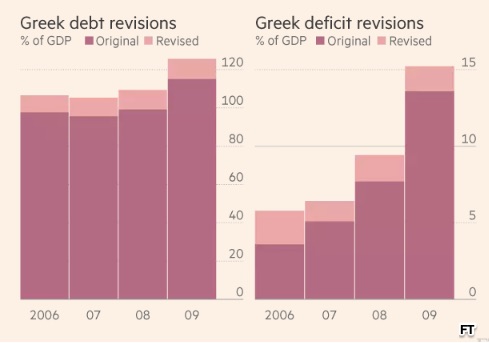
Before a bailout, though, looking for accurate statistics, in 2010, the EU sent Andreas Georgiou, a former IMF (International Monetary Fund) official, to Greece to overhaul the Greek statistics office. Uncovering numbers that were far more problematic than Greece had indicated, the EU demanded gargantuan government spending cuts.
The Greek debt and deficit were far larger than initially reported:
One woman said that Georgiou, “helped to destroy our country and ruin my family.” Like her, many others lost their jobs and retirement money as salaries and the minimum wage plunged by 20% while the legal retirement age went up. When the economy shrank by one quarter, and unemployment soared, young people left the country. At the same time, tax revenue rose as loopholes closed.
Fast-forwarding to now, with a fiscal surplus, Greece has been able to pay fuel subsidies, increase pensions, and grow its economy. Still, though, based on their per capita GDP, they are the second poorest nation in the EU.
Our Bottom Line: Fiscal Responsibility
The Wall Street Journal suggested that recent protests in France and Milan “looked a lot like Athens in 2010.” Returning to where we began, we can see that it’s tough to be fiscally responsible.
As economists, we can ask about the trade-off between short-term pain and long-term gain.
My sources and more: Thanks to WSJ for inspiring today’s post. From there, we went back to a Michael Lewis Vanity Fair article from 2010. Also, do take a look at our recent posts on France, here and here.