![econlifelogotrademarkedwebsitelogo[1]](/wp-content/uploads/2024/05/econlifelogotrademarkedwebsitelogo1.png#100878)


Who Pays for a Welfare State?
June 2, 2026
How Will Musical Instrument Tariffs Affect Our Orchestras?
June 4, 2026
Control of the Strait of Hormuz involves more than potato chips, tomatoes, Diet Coke, and condoms.
It is about data.
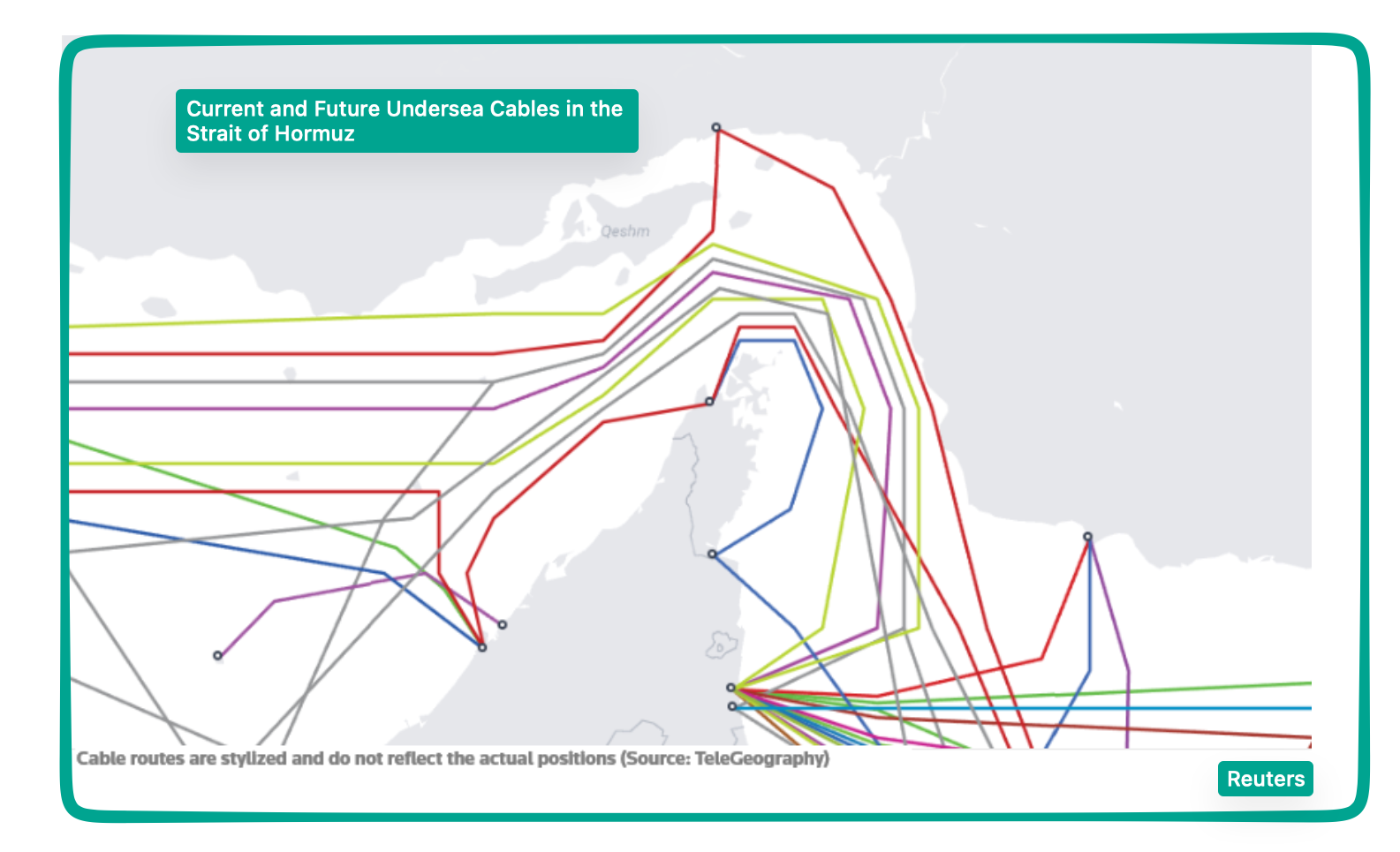
Strait of Hormuz Data Cables
The undersea fiber-optic cables that bring internet data to the Middle East, Europe, and Asia snake through the Strait of Hormuz. So, when a spokesperson for the Iranian government said they would “…impose fees on internet cables,” it jolted big and little tech. We were already worried that military maneuvers would accidentally (or intentionally) jostle the cables. But it is also possible that damaged vessels will disrupt a cable with a dragging anchor. Now, in addition, a tax could upset the free flow of data.
As much as 20% of the world’s internet and financial data flows through the Strait of Hormuz. With their cheap energy, Saudi Arabia, and the UAE hope to lure the AI investment that needs those undersea cables. In addition, the Strait of Hormuz is home to some of the cables that service our data dependencies like cloud storage, e-commerce, and streaming services.
These cables are a part of larger networks:
Our Bottom Line: Information Infrastructure
Thinking of an infrastructure, we could imagine transportation and our network of roads, airports, bridges, and all that we use for travel. We could picture the financial infrastructure that, starting with banks, moves our money from one place to another.
Somewhat similarly, our data travels through our information infrastructure. In a past post, we said the US Postal Service was a part of our information infrastructure. So too was the printing press, our stock tickers, and countless other devices and structures.
As for the internet, it has become an increasingly massive part of our information infrastructure: Moving from chips, to devices, to services, the structure grew:

Already dated, this 2021 graphic shows some of the components of our information infrastructure:

Returning to where we began, we can add invisible data to the impact of the Iran War.
My sources and more: Thanks to economist Ed Yardeni for alerting me to the data that travels through the Strait of Hormuz. From there, I discovered much more detail in this Reuters article. Then, looking for internet history, we can always go to this past econlife post.
Please note that several of today’s sentences are elsewhere in econlife.