Which Two Battles Will Be Fought at COP31?
November 11, 2026
The owner of Grand Cru, Fine Wine and Spirits in New Orleans said that 60% of the bottles on her shelves come from outside the U.S. Explaining during a BBC podcast, she said Champagne was one of her tariff problems. Fueling our inflationary bubble, “Champagne can only come from Champagne.”
Now, learning that Harvard’s Pricing Lab has some precise tariff data, we can confirm our Champagne story.
Tracking Tariffs
Harvard’s tariff trackers first asked who absorbs the tax (because it’s certainly not the country of origin). Instead, they concluded that consumers shouldered 45% of the burden. Correspondingly, without tariffs, CPI inflation would have exceeded the Fed’s two percent target by 20 basis points (.2 percent) rather than last August’s 100 basis points (1 percent).
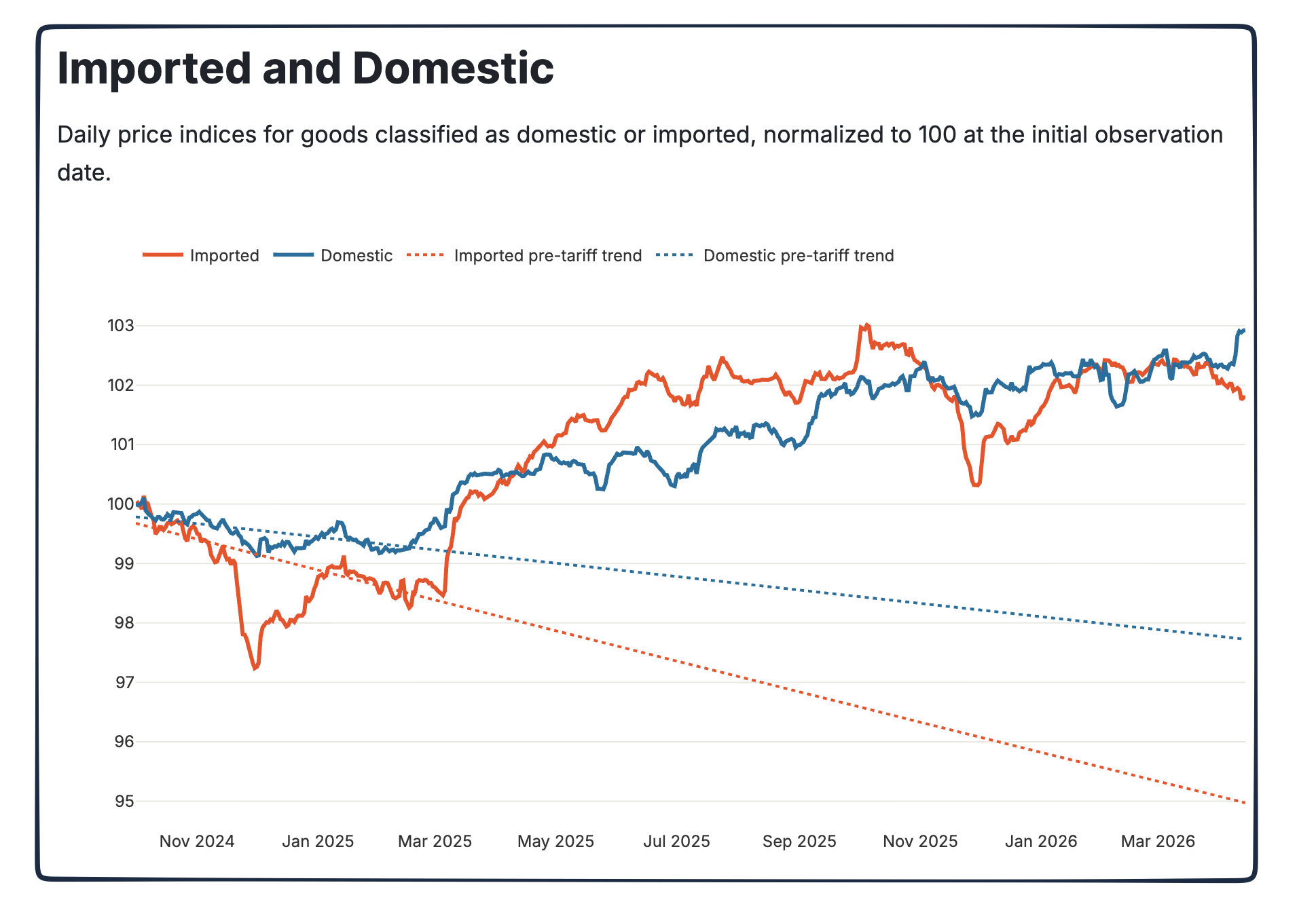
With the administration changing rates on a daily basis, the Harvard Business School’s Pricing Lab used AI to track 80% of the CPI basket sold by five major retailers.
They identified four patterns:
- For imported and domestic items, retail prices jumped just after March 4, 2025, and subsequently as rates rose further. Because retailers were initially selling pre-tariff inventories, it is likely that they expected higher replacement costs.
- Deviating from pre-tariff trends, prices continued to rise but more slowly.
- Domestic prices–even for items not directly tariffed–were up. The reasons could have been less competition, more expensive inputs, and higher expected inflation.
- Although considerably less than tariff rates, the increases are economically meaningful.
You can see the price ascent:
Our Bottom Line: Imports Impact
Harvard’s Pricing Lab and a 2018 BLS working paper find much more than correlation between imports and inflation. Proving that tariffs cause higher prices, their evidence indicates Increases that “were larger for imported than domestic goods and for affected than unaffected products within each group, with the domestic response pointing to competitive spillovers.”
Correspondingly, the BLS paper concluded that imports from China did indeed lower U.S. consumer prices. More precisely, a one percent rise in the share of Chinese imports brought consumer prices down by at least three percent. Always, though, as economists, we know there will be a tradeoff. The BLS paper estimates that the gains from lower prices cost us approximately $100,000 for each lost manufacturing job.
So, where are we? With the November 10 CPI release, we can at least partially blame tariffs for the sharp increase in the inflation rate, and for Champagne’s two kinds of bubbles.
My sources and more: Always, it’s a pleasure when two stories converge. Yesterday, it was a WSJ column and a World Business Report podcast. Then, we could further establish the causal connection between imports and inflation with Harvard’s Pricing Lab and this 2018 BLS paper.