![econlifelogotrademarkedwebsitelogo[1]](/wp-content/uploads/2024/05/econlifelogotrademarkedwebsitelogo1.png#100878)


Why the World Might See a Condom Shortage
May 4, 2026
Where to Find a Tobacco Smuggler
May 6, 2026
Now we know that a priceless Stegosaurus skeleton is worth $45 million.
Let’s take a look
Dinosaur Markets
Apex
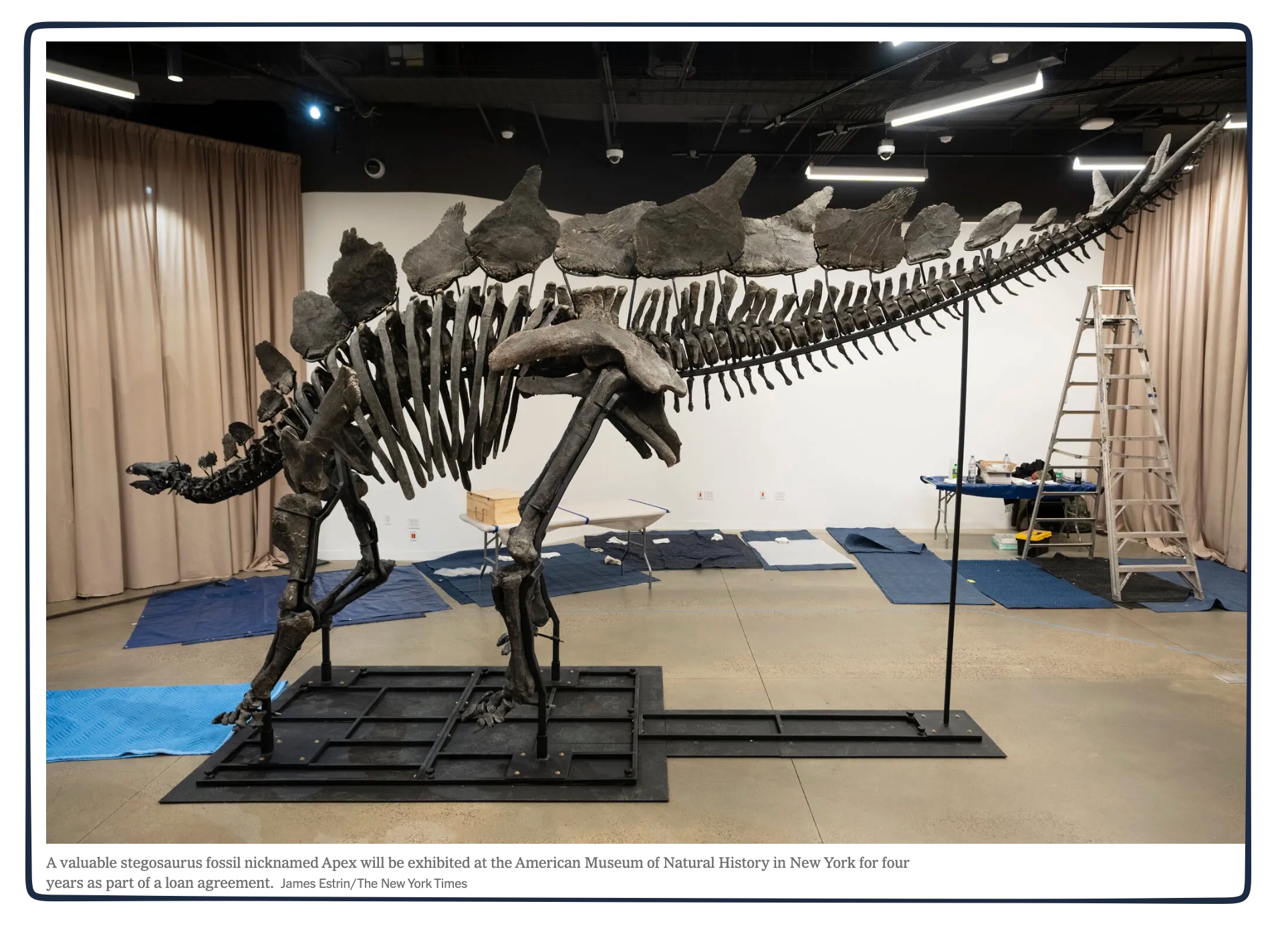
During July 2024, hedge fund billionaire Ken Griffn bought Apex, a Stegosaurus skeleton for $44.6 million. Found in Colorado, Apex soared in value from an estimated $4 to $6 million when a bidding war made him (her?) worth much more. Surpassing T. rex Stan’s $31.8 million price, the fossils market became hot.
Temporarily on loan to the Museum of Natural History in NYC, this is Apex:
 Fossil Dealers
An antiquities dealer explained how fossil sales were revolutionized by gob smacking prices. Informal for a long time, with little need to prove where or when the bones were found, now it is moving closer to art markets. As a result, the owners of a fossil have to prove where it came from. Ideally they have a video of the dig and ownership proof. They have to demonstrate how much is real and which bones came from a 3D printer. Similar to paintings, dealers want to know authenticity, provenance, the condition of the specimen.
Because of dinosaurs’ newfound value, we have many more dinosaur hunters. At a dig, finding nothing at first, people used to abandon the search. No more. They know that somewhere there is an affluent tech bro that might be interested. With price and prestige rising, so too has the number of dinosaur hunters.
As for future discoveries, in a young market, it’s tough to place a price tag on newfound skeletons. You need a history of transactions that won’t exist for a while. Looking back, we would see that the Abu Dhabi Natural History Museum bought Stan (T. rex) at a Christie’s auction for $31 million. Before that though, Sue (T. rex) went for $4 million. Then there was Big John, a Triceratops, that fetched $7.7 million.
Our Bottom Line: Markets
Defined by economists, a market is a process rather than a place. When it functions optimally, the process uses supply and demand to determine price and quantity. On the supply side, producers know the value of their land, labor, and capital. Then, for demand, the normal laws tell us that lower prices increase the quantity people are willing and able to buy. But for dinosaur hedge fund buyers the normal rules evaporate.
And as for you and me, we could always buy a T. rex tooth fragment for $500.
My sources and more: Thanks to the always interesting Odd Lots podcast for its look at antiquities markets. From there we found out more about the Ken Griffin sale in the NY Times. As for other dinosaurs, National Geographic told us about Stan here and Big John here.