![econlifelogotrademarkedwebsitelogo[1]](/wp-content/uploads/2024/05/econlifelogotrademarkedwebsitelogo1.png#100878)


How Are Emerging Markets Hit By the Iran War?
March 23, 2026
Why Might SUV Demand Soon Plunge?
March 25, 2026
Recently, we’ve seen how grade inflation is tough to tame. Yes, a higher grade helps high school students get into college and college students get into graduate programs.
But like many of us are willing to accept short term gain for long term pain, there is a downside.
Grade Inflation
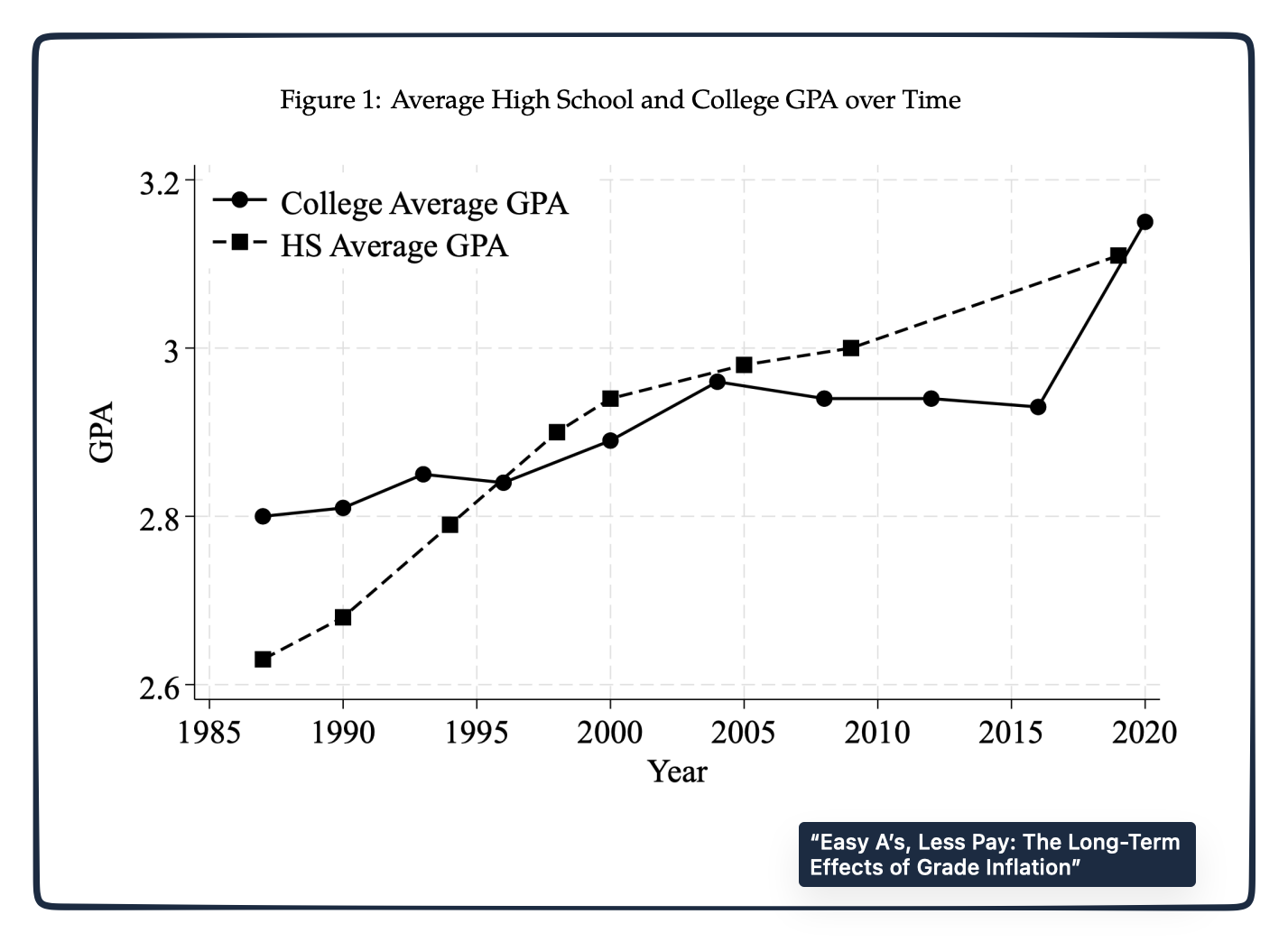
Tilting toward “A’s,” grade averages have ascended since 1985:
The Debate
- Teachers that tend to be more inflationary provide lower cognitive value-added. However, students could be encouraged by their elevated performance. Although they learn less, still students do keep learning.
- By contrast teachers that give lower more realistic grades create more learning in their classrooms. While students have the incentive to study more, the challenges could be discouraging.
Looking more closely, a recent study distinguished between passing and mean grade inflation. As you might expect, teachers implementing passing grade inflation give the grade bump to pass a student onward to the next grade, perhaps from an F to a D or C-. On the other hand, mean grade inflation affects grades throughout the term, consistently raising them. Both though can reduce lifetime earnings by approximately $213,000.
In addition, they impact future test scores, graduation rates, and post secondary enrollment.
Passing Grade Inflation
Lower achieving students benefit more from passing grade inflation although there was no observed impact on their test scores. While they are more likely to graduate within five years from high school and enter Associate degree programs (but don’t necessarily graduate), they are less likely to enter and graduate from Bachelor’s degree programs. But, passing grade inflation can increase the possibility of getting a job–perhaps because of the diploma.
Mean Grade Inflation
Mean inflation reduces a student’s test scores during the next year, the likelihood of graduating, of being employed one to four and six years after expected high school graduation, and of enrolling in college. Also, students tend to perform less optimally on high school standardized tests like the SAT. Researchers pointed out that higher achieving students suffer from mean inflation because they can perform better with less effort and less learning.
Our Bottom Line: Human Capital
Just like a factory owner increases physical capital with more tools and technology, we build our human capital by accumulating education, informal knowhow, and our psychological equipment. These cognitive and non-cognitive attributes let us optimize our potential.
Indeed then, we can ask if grade inflation prevents us from fully developing our potential.
My sources and more: Thanks to Marginal Revolution for alerting me to the grade inflation study.
Please note that parts of “Our Bottom Line” were in a past econlife post.