What France (and Even the U.S.) Can Learn From Greece
November 15, 2026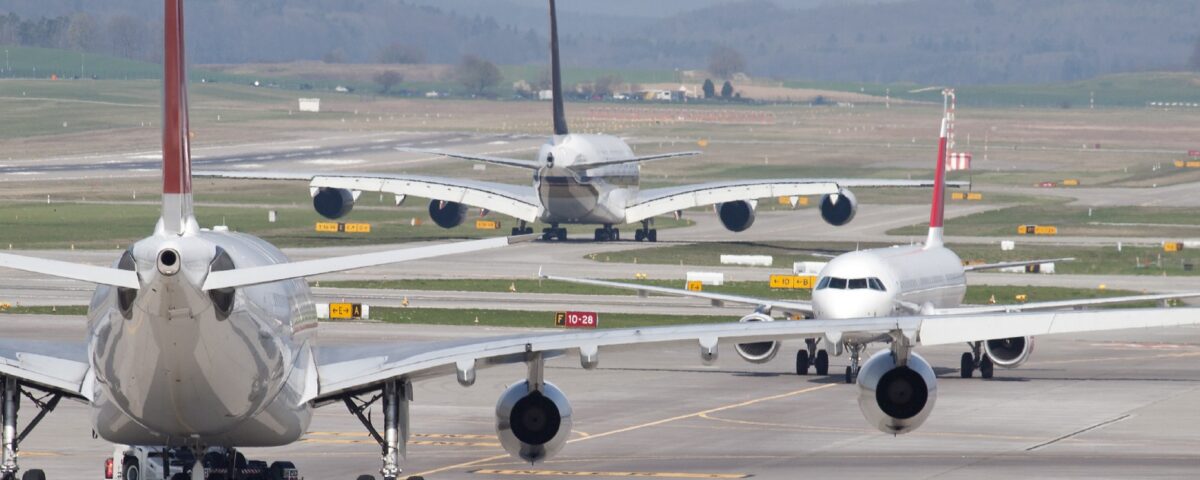
On Friday, November 13, 2026, at approximately 3:30, the FAA sent our newsfeeds an eye-popping attention-getter. Because they had proclaimed a nationwide ground stop, most U.S. air travel was at a standstill. Eventually attributed to a router installation that did not quite work as planned, the problem was really about more than one gargantuan glitch that lasted approximately 4 hours and 45 minutes.
It was about an aviation system that got a D+ grade.
The Civil Engineers’ Aviation Report Card
Every four years, the American Society of Civil Engineers (ASCE) publishes an infrastructure report card for the U.S. Our current C average is a notch up from 2021’s C-. Although one source of the improvement–the IIJA (Infrastructure Investment and Jobs Act)–expired during September, spending for most categories continues:
 Aviation
For aviation, past IIJA allocations have yet to be entirely implemented, while the “aviation trust fund,” established in 1970 has also been a major source of funding. The targets include airport improvements, air traffic control facilities, and a control tower overhaul:
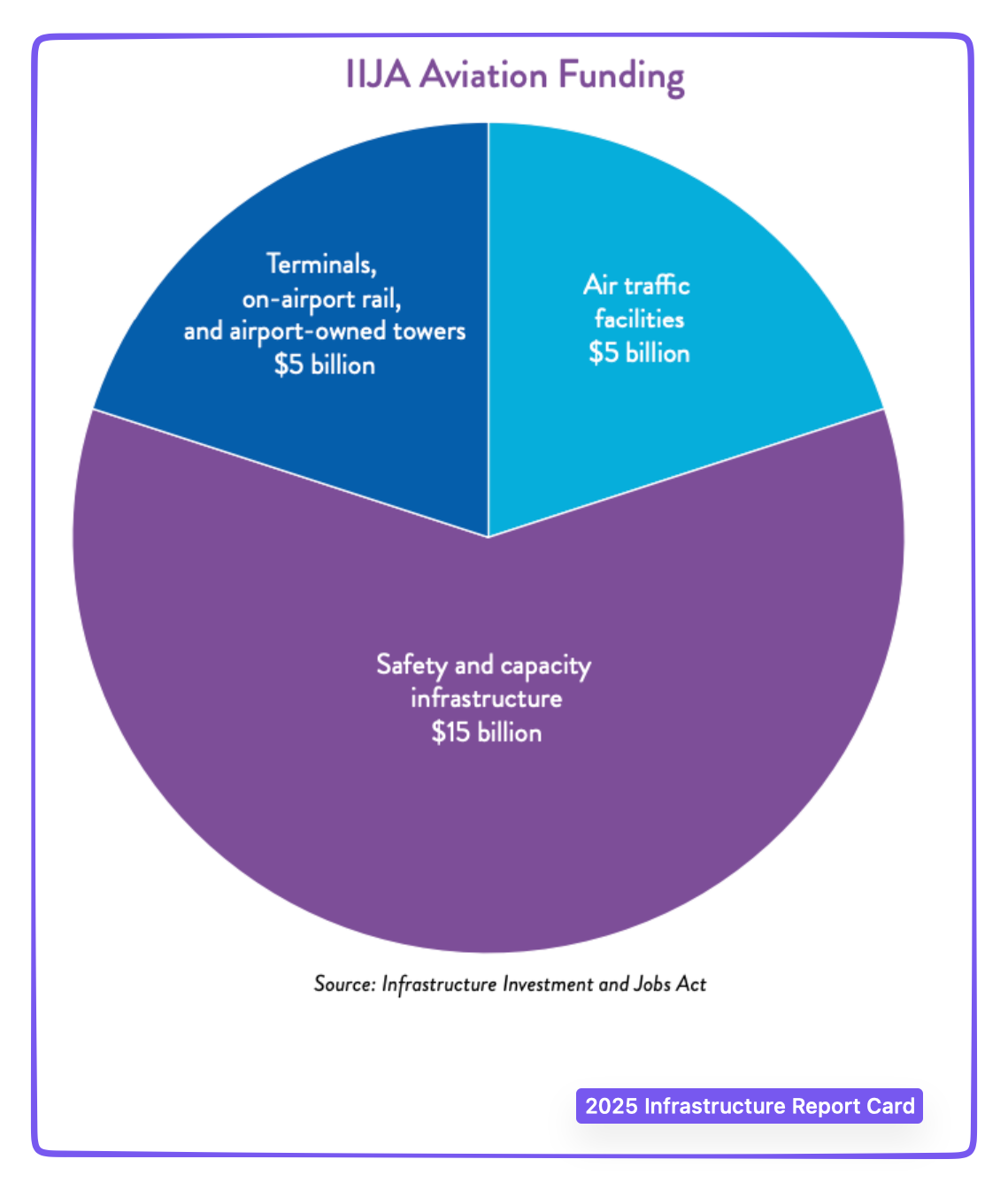
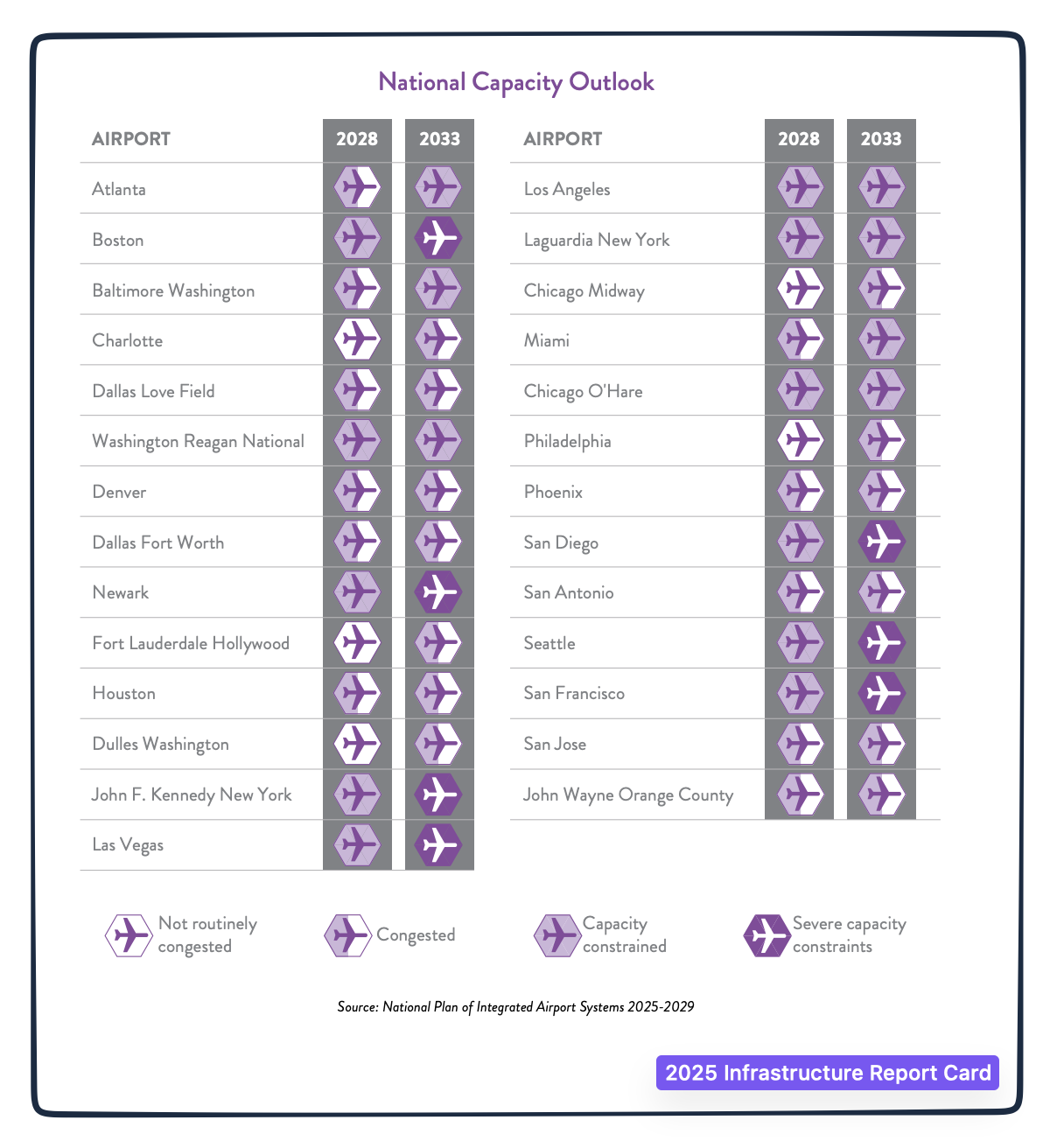
The ASCE report card says aviation will have a funding gap of $114 billion during the next decade. While the gap can impact all 13,144 U.S. airports, it mainly relates to far fewer, to the 3,247 that comprise the backbone of the system. Furthermore, defining an airport, they are also referring to the “runways, taxiways, control towers, firefighting and rescue services, passenger terminals, cargo facilities, general aviation facilities, parking garages, access road networks, public transport, lighting, navigational and approach aids, and various support facilities.” Affecting multiple parts of the airport, at 15.7 million in 2023, the number of enplanements has steadily increased.
Consequently, you can see why airport capacity will be a challenge by 2033 at most major airports.
Our Bottom Line: Spillover
The economic term spillover seems uniquely appropriate for tracking the impact of our transportation infrastructure. Including the positive or negative externalities that affect unrelated third parties, the spillover from roads, canals, railways, autos, and air travel ripples far beyond the specific artery. Contributing 4.9% to the GDP, the U.S. aviation industry alone employs close to 10 million workers. So, when we have a system outage, the spillover is massive.
My sources and more: Always handy, the 2025 Civil Engineers report was today’s springboard. From there, we looked at Reuters articles, here and here, and then ChatGPT linked me to the FAA and Transportation Department groundstop briefings, here and here. And finally, we checked an aviation 2024 Government Accountability Review and a Congressional Research Aviation Report.