![econlifelogotrademarkedwebsitelogo[1]](/wp-content/uploads/2024/05/econlifelogotrademarkedwebsitelogo1.png#100878)


When Stock Markets Have More Losers Than Winners
July 7, 2026
Why Game Theory Explains World Cup Penalty Shootouts
July 9, 2026
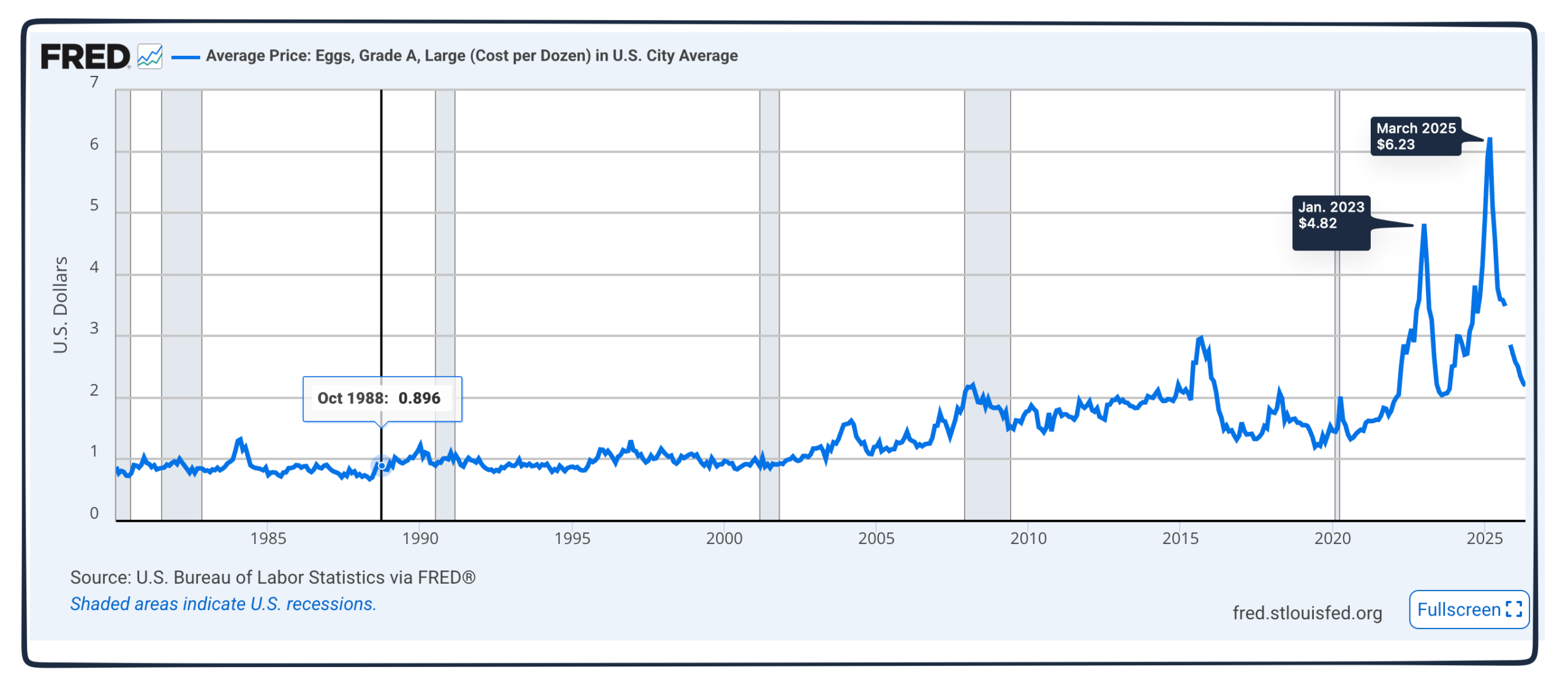
During September 2024, we explained why egg prices were so high. Saying, that the reason was bird flu, we blamed supply and demand. With the number of egg laying birds descending, shrinking supply nudged prices skyward. In Colorado, one egg-laying operation reported having “culled” 6 million birds with plans to kill another 1.8 million.
The average price peak was $6.23:
We had not known that there was much more to the story.
Egg Price Fixing
Recently released court documents revealed that, by fixing prices through collusion, the three largest egg producers had violated Section 1 of the 1890 Sherman Antitrust Act. Although they admitted no wrongdoing, still they agreed to donate more than 53 million eggs to food banks and nonprofits in the plaintiff states. The deal also included a $3.3 million cash payment and further government oversight.
Investigators’ became suspicious when Cal-Maine (largest egg seller) reported unusually high profit margins. Also, the price difference between conventional caged-bird eggs and cage-free egg prices was backwards. Conventional eggs should not have been more expensive when cage-free reflected real markets.
But how did the producers cooperate?
Our Bottom Line: Egg Indexes
Egg experts tell us that a 1% decrease in supply leads to a 6.6% price increase. As a result, when the 2022-2024 1% decrease led to a 17% to 33% price pop, it looked fishy.
It turns out that markets do not determine most egg prices. For just 11% of eggs, there is a competitive wholesale spot market that identifies prices. Otherwise, buyers and sellers negotiate long term contracts based on a price index. First, industry participants, including processors, buyers, and distributors, provide their egg and chicken facts to the index. Then, the index compiles a slew of numbers that is sold back to the entities that initially gathered them, and they decide what to charge.
During bird flu, the pricing system became the ideal vehicle for setting high prices. The big egg producers each just had to constrain demand and report high egg prices. Then, in what sounds like a rather circular process, those higher prices were returned to them by the index as guideposts for setting egg prices in their contracts.
Actually, there had been a somewhat similar chicken price fixing episode that was also in the courts. At that time, the big chicken producers fed inflated prices to a regional price index.
So, asked which came first, the chicken or the egg, for price fixing, it appears to have been the chicken.
My sources and more: For today’s facts, we began with Yahoo Finance and the NY Times. But then, the perfect explanation of egg prices came from a 2025 Washington Monthly article.