![econlifelogotrademarkedwebsitelogo[1]](/wp-content/uploads/2024/05/econlifelogotrademarkedwebsitelogo1.png#100878)


Which States Are Most Popular?
June 11, 2026
June 2026 Friday’s e-links: A Novel Recommendation
June 12, 2026
Knicks fans were euphoric after their team’s historic Wednesday win. During game four’s last moments, they overcame the Spurs’ 27 point lead.
Economists have studied our emotions after our team wins and when it loses.
There is more sadness than we expect.
Losers’ and Winners’ Emotions
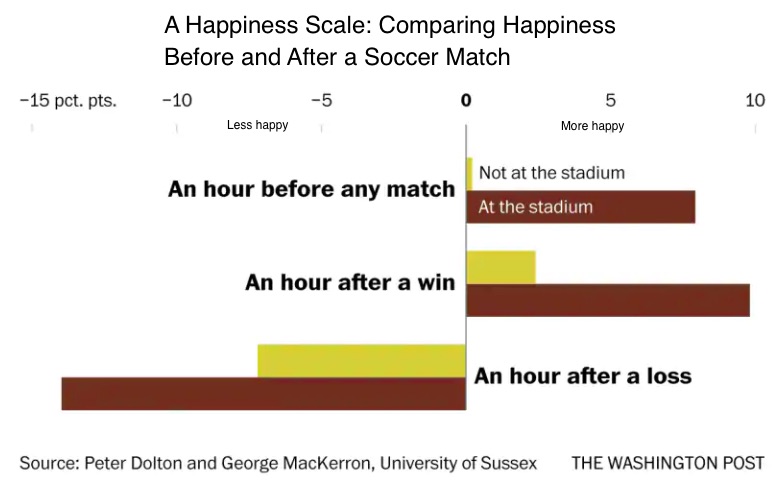
In a 2018 study, economists monitored the happiness of 32,000 fans during 3 years of British soccer matches. Controlling for variables like the time of day and location, they observed happiness fluctuations before, after, and during the games through a smartphone app. On their scale, fans were 3.9 points “happier than usual” with a win for their team and 7.8 points sadder if their team lost.
And it gets worse. Because the losers’ sadness lasts longer than winners’ happiness, those down feelings are close to four times any upside that winning created.
Furthermore, attending the game intensifies how you feel. In Madison Square Garden, the happiness surge could have been three-to-four times higher than those of us watching from home. Even before the game began, in-stadium fans experienced a burst of pleasure.
Similarly, the night before when the Knicks lost, the fans in MSG, would have experienced a drop of 14 happiness points rather than the 7.8 point average. Also, they suffered more than the home audience.
Below, you can see that people felt the pain of loss more acutely than the joy of winning:
Investing
University of Chicago economist John List suggests that investors ignore stock market fluctuations because they too feel loss more intensely than winning. People who are down $1000 experience the drop more so than if they had been up by the same amount. The result? Most of us sell when stock prices plummet…precisely when we should be patient. Or, we hold on too long because we want to avoid the reality of a loss. Either way, the pain of loss makes us sell at the wrong time.
Our Bottom Line: Loss Aversion
Called loss aversion by behavioral economists like Nobel economics laureate Daniel Kahneman, our desire to avoid a loss affects how we feel and act. For many of us, the dismay over losing a $10 bill exceeds the happiness we feel when we find one:

Hard to believe, but based on the Sussex study, there was more sadness in the world after the Knicks won.
My sources and more: Seeing so many happy Knicks fans reminded me of this Washington Post article. A perfect summary, the Post article then linked to more detail from the University of Sussex. I also referred to ESPN for game four details.
Please note that several of today’s sentences were in a past econlife post.