![econlifelogotrademarkedwebsitelogo[1]](/wp-content/uploads/2024/05/econlifelogotrademarkedwebsitelogo1.png#100878)


When the Cost of a Snowstorm Is Money and More
January 26, 2026
When “Pre-owned” Is Pricey
January 28, 2026
Because 19 states hiked their minimum wage, some of us will earn more. The cost though can be more than the wage.
Let’s take a look.
Minimum Wage Hikes
Where
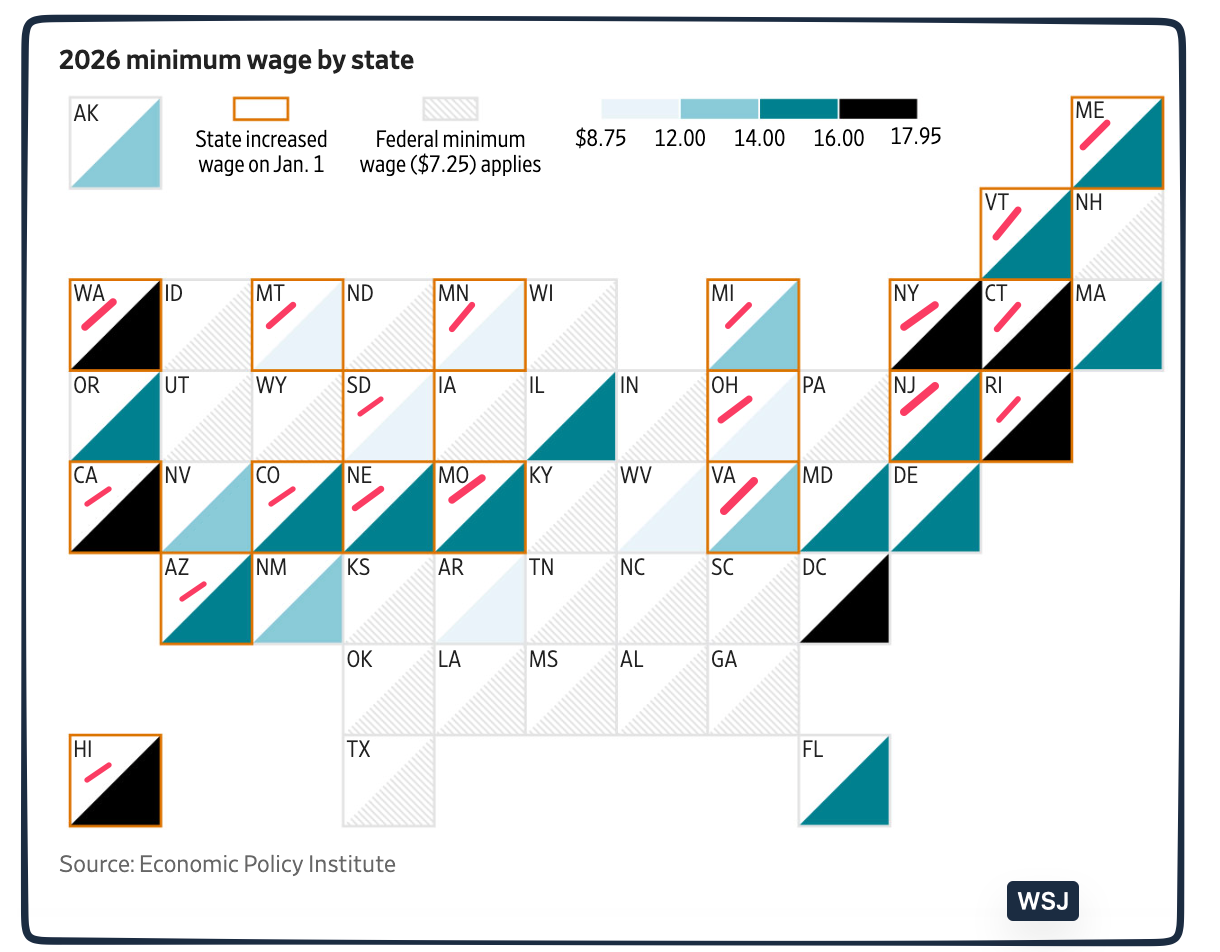
Established in 2009, our starting point is a federal minimum hourly wage of $7.25. At the other end of the scale, we have Washington state at $17.13 and Seattle mandating $21.30. Meanwhile Hawaii, at $2 more an hour, had the biggest leap from a $14 to $16 minimum wage.
Below, the “beige” squares are the federal minimum wage states while the black triangles pay the most. I placed a red line on the 19 states that hiked the wage:
Our Bottom Line: The Price Floor Debate
Our graph will take us to the tradeoffs.
The Graph
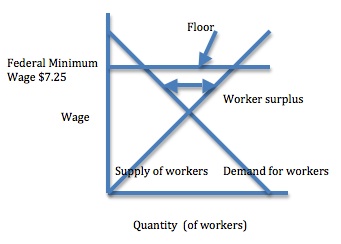
With the minimum wage, government solves a problem we could call market failure. The failure is too low an equilibrium wage. On a wage graph, we have the supply curve representing the workers and demand is the employer side. When we assume that the equilibrium wage is too low, government steps in with a higher minimum:
The Tradeoffs
While our graph shows a worker surplus, there are many other possibilities. They range from price hikes to Channels of Adjustment.” In one study, involving 10,000 outlets and 300 minimum wage changes that included 42 cities, customers paid more. Alternatively, because of a 25 cents minimum wage hike, delivery people at a NYC pizza establishment no longer hang out until they get a call. Instead, they had new responsibilities that cut their “down time.” Through another study in Georgia and Alabama, researchers again cited rising prices (on combo meals) but also they uncovered a compressed wage structure with higher paid workers receiving lower raises. In addition, they saw less hiring and firing because training cost $300 to $400 a person. Other results included less overtime, better inventory control and more for each worker to do.
Returning to our title, what is the surprising cost of the minimum wage hike? Remembering that cost means sacrifice, the cost is all of the possible tradeoffs.
My sources and more: Thanks to the Wall Street Journal for inspiring today’s post with yesterday’s article.



2 Comments
It should be remembered that a number of economic studies (e.g., NJ vs PA, also WA) have shown that increases to minimum wage often have little effect on employment. In many cases, this is due to partial monopsony in the labor market.
Frictionless labor markets can (and in numerous pre-modern societies have) driven wages to just above actual starvation (the supply-driven lower bound). The dynamic is the same as the one that drives capitalists to zero profit in perfect competition. No one has ever convincingly proven that (apart from temporary shortages due to new business opportunities) anything other than customary or governmentally imposed labor market frictions can defeat the iron law of wages. Anonymous consumers will chose low prices from slavery as well as from impoverishment.
A necessary addition to my post. Thanks, Rick.