![econlifelogotrademarkedwebsitelogo[1]](/wp-content/uploads/2024/05/econlifelogotrademarkedwebsitelogo1.png#100878)


A Very Large Reason For Rising Gas Prices
September 23, 2026
Where AI Creates and Destroys Jobs
September 25, 2026
The 10-year Treasury is a benchmark and a crystal ball.
So let’s take a look.
6 Facts: The 10-Year Treasury
1. What is a bond?
Bonds are a way that corporations and governments raise money. Instead of going to a bank for a loan, they can sell bonds to investors.
We just need to imagine an exchange. When a bond is first created, the bond seller gets some money for a predetermined period of time. Meanwhile, the bond buyers not only get the bond repaid in the future, but they also receive interest or a discounted bond price. Bond buyers though, need not wait until their bonds mature and the issuers repay them. Instead, they can sell them in bond markets.
The U.S. Treasury calls its bonds T-notes when they have a 2- to 10-year maturity and T-bills if the payback is one year or less. The word T-bond applies to the longest-term maturity, the 20- to 30-year.
2. How much might the 10-year pay us?
When it first issues a 10-year note, the U.S. Treasury tells buyers the interest payment that we can call the note’s yield. They determine that amount through an auction. At the auction, bond buyers offer bids. The highest bid then establishes the dollar amount that the note or bond will pay semi-annually to bondholders. Instead, though, we can buy short-term bills at a discount. Hypothetically, that means a bill that would pay $100 when it matures would be purchased for $95.
3. How does the price of a bill, bond, or note relate to its yield?
Using hypothetical numbers, let’s just say a Treasury auction determines a $5 payment for a $100 note. As a result, the yield is 5 percent. Then, though, because the $5 is a constant, the yield (always a percent) fluctuates. If someone is willing and able to buy your bond for $200, the $5 payment creates a 2 1/2 percent yield. By contrast, when the sale price is $50, then the yield–what the note pays us–is 10 percent. Oversimplifying complicated markets, we can just say that note prices are the equilibrium point where the quantity supplied of notes and the quantity demanded for them meet. Consequently, as in all markets, equilibrium prices change when our demand and/or supply curves shift. And the price and yield move in opposite directions.
4. How safe are Treasuries?
One word to remember when we refer to Treasury bills, notes, and bonds is safety. Because the federal government has never defaulted and investors assume it never will default, Treasuries are one of the safest places to park your money. Since an interest rate reflects the safety of an investment–risky issuers pay us more interest–Treasuries pay the lowest rates.
5. Why do 10-year Treasury interest rates matter?
As the lowest amount investors receive for a very safe bond, the 10-year is a benchmark. It is the interest rate on which other longer-term rates are based. It’s the lower rate while other chancier investments are higher. As JP Morgan explains, when the 10-year yield rises, “30-year fixed mortgage rates also typically climb, making the cost to borrow money to buy a home more expensive. When the yield falls, borrowing may become more affordable, which can help boost the housing market and consumer spending.”
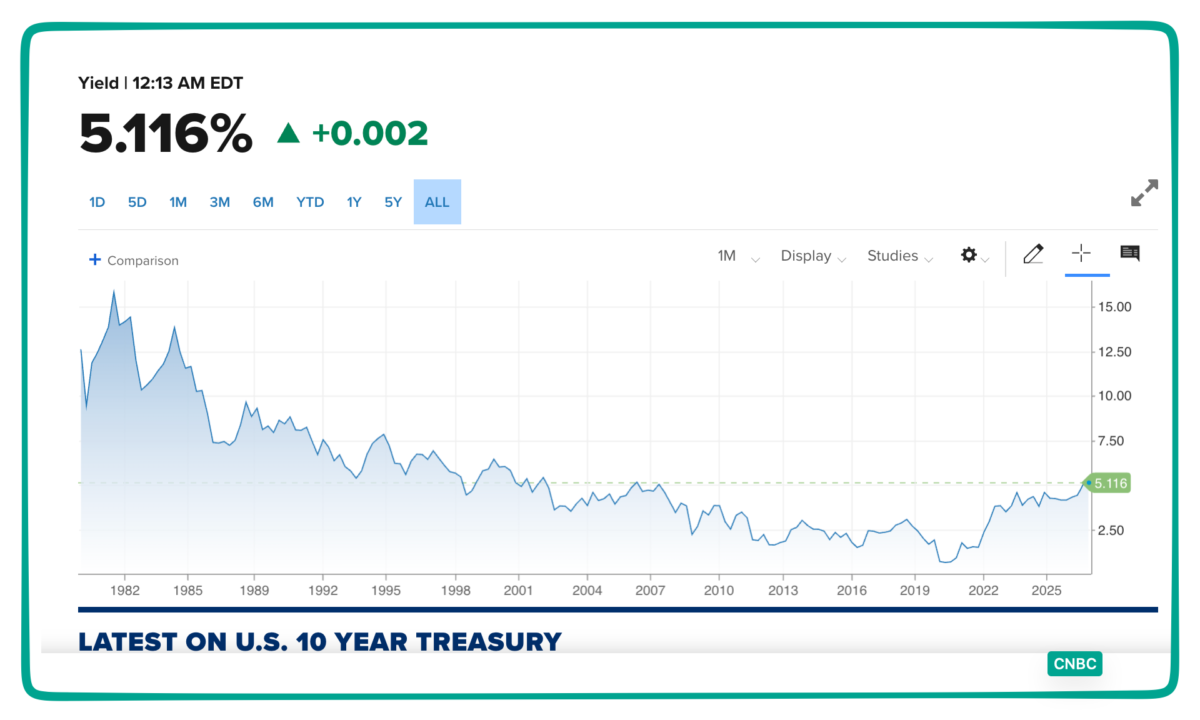
6. Why is 5.14 percent significant?
As a 19-year high, the spike in the 10-year rate during yesterday’s intraday trading could be a signal that bond markets are worried about inflation.
You can see the yield entered record-setting territory:
Our Bottom Line: the Bond Vigilantes
Bond markets are chock-full of information. When the 10-year’s yield rises, the message could be smiles about future growth or inflation worries. By contrast, falling yields signal the possibility of a weaker economy or even a recession. So yes, bond markets can be a crystal ball predicting inflation and growth.
Because of their relentlessly realistic reaction to economic conditions, economist Ed Yardeni (in 1983) said we should be very aware of the “bond vigilantes.” Those vigilantes are large institutional investors like hedge and pension funds. Concerned with what they consider to be unwise fiscal or monetary policies, they sell bonds or refuse to buy new ones. Responding, the rates that rise can exert pressure on the politicians who want them to be lower.
My sources and more: Thanks to Cary (and his comments during dinner) for inspiring today’s post. From there, we went to this J.P. Morgan explanation of why the 10-year is so important.