![econlifelogotrademarkedwebsitelogo[1]](/wp-content/uploads/2024/05/econlifelogotrademarkedwebsitelogo1.png#100878)


How Taylor Swift Can Cause Distracted Driving
March 2, 2026
The “Traffic Jam” at the Strait of Hormuz
March 4, 2026
None of us knew for sure that the Supreme Court would say the International Emergency Powers Act of 1977 (IEEPA) had no tariff power.
But it did.
And now, we do not know if the illegal tariffs will be refunded.
But investors do know when they have an opportunity to make money.
Maybe.
Selling Tariff Refunds
Since April 2, 2025, a vast array of businesses started paying the tariffs levied by the Trump administration. The vast bulk (though not all) of them were supposedly authorized through IEEPA. Until February 20, 2026, the federal government collected close to $160 billion in IEEPA tariff revenue. Trying to decide who paid those tariffs, the New York Federal Reserve estimated that U.S. importers paid 94% of the money.
Because they should never have had to pay those IEEPA tariffs, U.S. importers should get a refund. However, no one knows when and how (and if) the IEEPA money will be returned. But the businesses that won’t want to wait have an alternative.
It’s the market.
Tariff Refund Markets
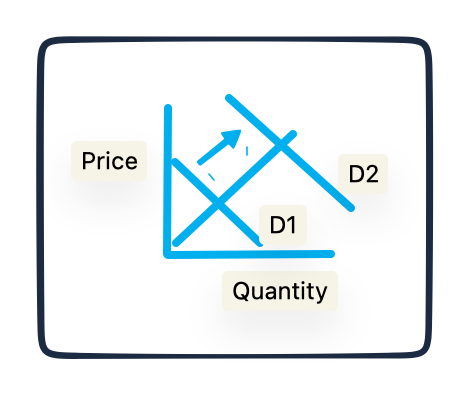
On the supply side, we have businesses that are willing and able to sell their refunds. Correspondingly, there are buyers creating demand. Together they create a price. Before the Supreme Court decision, the risk was considerable that importers would not get the payback. Consequently the equilibrium price was 20 cents of the dollar. Now though, our demand curve has shifted to the right. With refunds more likely, price rose to 40 cents for each refund dollar:
According to NPR, Seaport Global has been getting calls from importers asking if anyone wants to buy their tariff claims. As they described, it could be a $20,000 refund that, right now, the importer would sell for $4,000. Responding, Seaport Global looks for investors willing to buy the claims. They pay less on each dollar (i.e. $4,000 for a $20,000 refund) because of the risk they might get nothing and the wait for the money if they do get paid.
Our Bottom Line: The Wisdom of Crowds
In The Wisdom of Crowds, former New Yorker columnist James Surowiecki says that crowds can make decisions that are more accurate than individuals. After all, monopolistically competitive markets price commodities that range from t-shirts to tennis lessons. Studies even demonstrate that crowds’ guesses at state fairs cluster around the true number of jellybeans in one of those giant jars.
Similarly, the “crowd” now is telling us that it is more likely that importers will get tariff refunds. We can ask if, like jelly beans, the crowd will be correct.
My sources and more: Today’s facts initially came from NPR. From there, the Tax Foundation explained how much tariff revenue would have been collected from IEEPA and the New York Fed said it would come from U.S. importers.