![econlifelogotrademarkedwebsitelogo[1]](/wp-content/uploads/2024/05/econlifelogotrademarkedwebsitelogo1.png#100878)


Our Weekly Economic News Roundup: From SNAP Candy to Harvard’s Grades
February 7, 2026
How a Sunday Game Affects Monday Work
February 9, 2026
Your counterfactual could determine whether you are happy with your Olympic medal.
For silver winners it’s upward while bronzers look downward.
Silver Medal Sadness
Called the silver medal paradox, silver medal winners tend to be less happy than the athletes who win bronze.
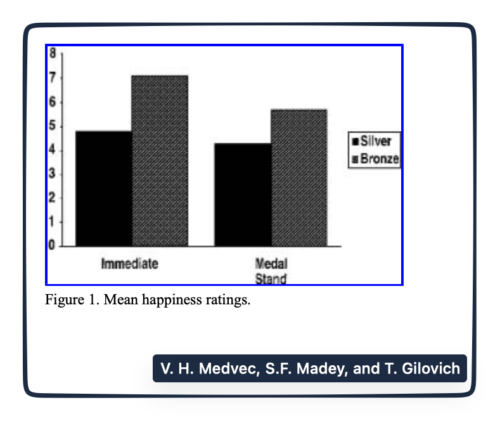
In one paper, psychologists used shots of 20 silver and 15 bronze 1992 medal winners. Study participants then rated the expressions on a 1 to 10, agony to ecstasy scale in which 1 is agony and 10 is ecstasy. The mean for the silver medalists was 4.8 whereas bronze was 7.1. Measured another time, the silver average was 4.3 and bronze, 5.7.
You can see that bronze winners, in the bars on the right, have higher happy scores:
But more than a graph, this silver medal winning hockey team says it all.
At Sochi, 2014, the Canadians got the gold and the Swiss, the bronze. They were ecstatic but, displaying silver medal sadness, the US team looked morose:

Our Bottom Line: Counterfactuals
By counterfactual, we mean “what could have been.”
As a behavioral economist, we say that silver and bronze medalists feel differently because one looks up and the other, down. Silver medalists focus on the counterfactual that could have been. They think, “if only…” and “why didn’t I just…” By contrast, bronze winners tend to take pride in having won a medal and topping so many other competitors. The silver medalist focuses “upward” on the gold winner as a reference point. Meanwhile the bronze thinks “downward” about the fourth place (and lower) she thankfully avoided.
As we all know, similar counterfactuals exist everywhere. If we miss a plane by 5 minutes, we think that we could have arrived sooner. However, arriving 2 hours late is less frustrating. Indeed, looking up at what could have been makes us feel worse. By contrast, the downward counterfactual is comforting.
Thinking of the Olympics and downward counterfactuals, we could just say, ” Less is more.”
My sources and more: This 1995 study explains silver medal sadness. But for more, this Axios article was recent, had extra details, and our featured image. And finally, for the more general counterfactual perspective, The Decision Lab had the discussion.
Please note that several of today’s sentences were in a past econlife post.