![econlifelogotrademarkedwebsitelogo[1]](/wp-content/uploads/2024/05/econlifelogotrademarkedwebsitelogo1.png#100878)


How Boarding Makes a Difference
February 5, 2026
February 2026 Friday’s e-links: Surprises From the Sewing Machine
February 6, 2026
The usual rule for a parking space is, “You leave it you lose it.”
Not always.
Parking Chairs
In Pittsburgh, you can save a spot by shoveling it.
Described in a WSJ article, a man named Jon had just spent two hours shoveling snow. Then, having cleared the parking space, he placed a chair in the middle of it. As a marker declaring temporary ownership, the chair would remain until his wife parked there after work. Most people knew not to touch it.
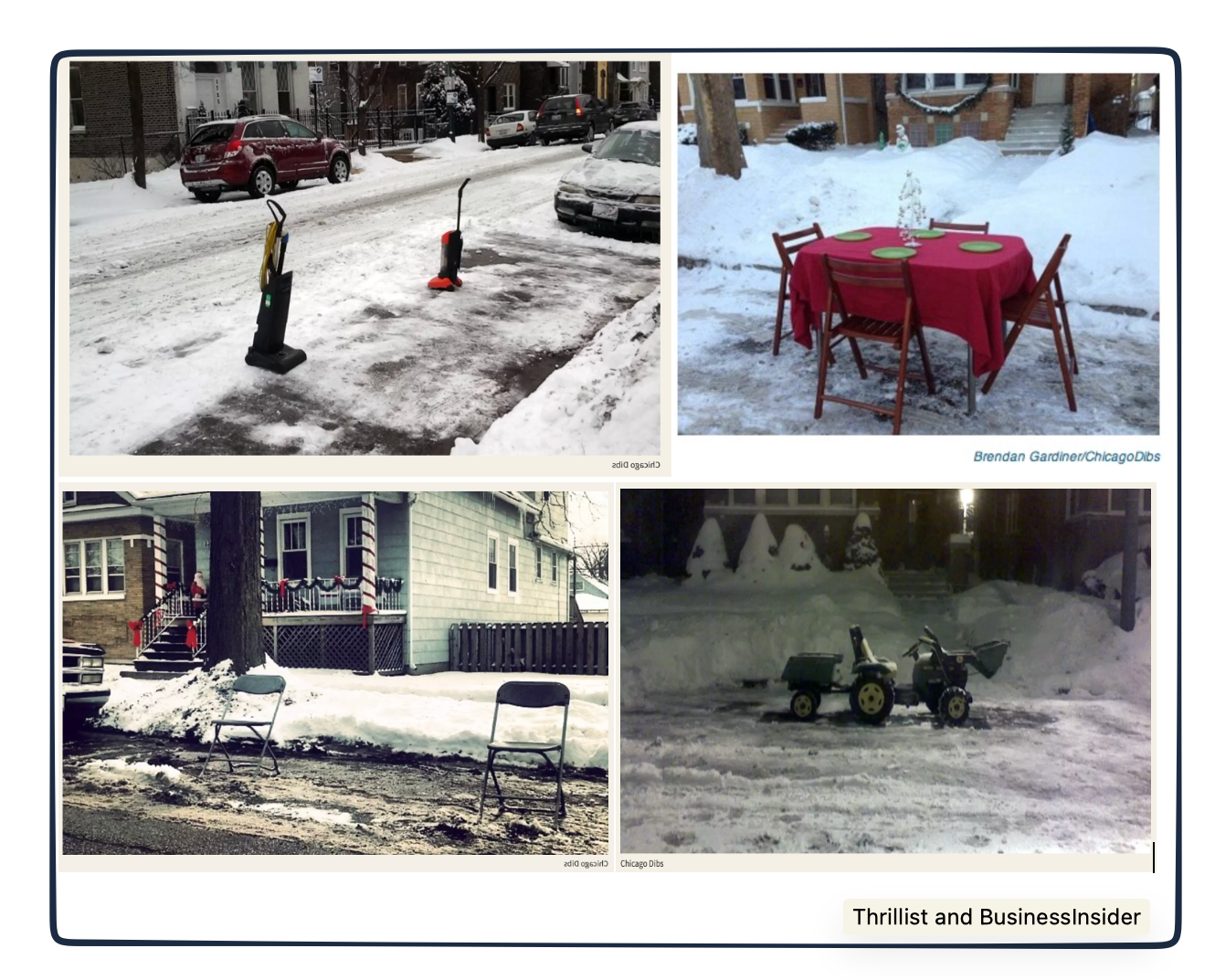
In other cities also, you can claim a parking space after a snowstorm by shoveling it. Called “winter dibs,” in Boston or Chicago you just leave a chair, a pot, or maybe a table, to reserve the space when you are not using it.
Winter dibs markers:
By contrast, the mayor of Baltimore said, “”Don’t do it …If I see your chair, it’s coming with me and going into the trash.” And while Philadelphia has also prohibited “savesies,” it is debatable in South Philly.
The Debate
Winter dibs infuriates some people. They say that city parking belongs to everyone, that the streets are free and, “You leave it, you lose it.” According to former NY Times Ethicist Randy Cohen, “Shoveling out your car is simply the price you pay for storing your private property in our public space.” If we adopted the winter dibs concept, people would even claim the sidewalk was theirs after clearing its snow.
A University of Chicago economist disagrees. Citing a John “Lockean” defense, she says that by investing labor, you create temporary property rights that add to your private “wealth” for several days and also help society. Because of “dibs” the number of shoveled spots increases. And, just like no one washes a rental car, you do a better job when the space is yours–far better than a city plow would have done. We could even say (as did a Northwestern law professor) that the invisible hand is “hoisting a snow shovel.”
Our Bottom Line: Property Rights
According to two Columbia law professors, several ownership rules explain why we can say a shoveled space belongs to us. In MINE! How the Hidden Rules of Ownership Control Our Lives, they tell us that being first to claim something has traditionally designated ownership. Also, inputting your labor, attachment, and physical possession solidify your ownership rights.
Centuries ago John Locke said that when we mix our labor with a state of nature, common property becomes private. In the U.S., Alexander Hamilton knew that a market economy required a contractual system that preserved property rights.
But we do have tradeoffs. Property rights are exclusionary. What could have belonged to everyone now belongs to an individual (or an entity). On the other hand, property rights create productive incentives. Because of winter dibs, more spots are shoveled more thoroughly.
With some cities saying yes and others no, winter dibs best demonstrates property rights tradeoffs.
Please note that, as an update, today we have included paragraphs from past econlife posts.
My sources and more: Yesterday, the WSJ reminded me it was time to return to the “parking chair.” Other current and past articles wonderfully debated the norm. In South Philly, the debate continues while Baltimore won’t allow it. In the past, we looked at “The Ethics of Winter Dibs Parking, and econlib’s “Snow Job”. As for fun pictures, Thrillist had a slew.