![econlifelogotrademarkedwebsitelogo[1]](/wp-content/uploads/2024/05/econlifelogotrademarkedwebsitelogo1.png#100878)


What Does SpaceX Get Paid For?
June 9, 2026
Which States Are Most Popular?
June 11, 2026
According to yesterday’s annual report from their Trustees, Social Security and Medicare have been hit by a triple whammy. Their promised benefit levels will sink because of fewer immigrants, a declining fertility rate, and the 2025 tax law.
If the President and the Congress do not figure out a solution, soon, you and I will not get our entitled benefits.
Social Security Problems
For Social Security, the two numbers to remember are 70 million and $160.2 billion. With 70 million individuals receiving Social Security benefits, we wind up with a $160.2 billion shortfall.
However, the shortfall does not matter YET because a Social Security trust fund makes up the difference when the program’s costs exceed its revenue. But, in 2032, it will not. In just six years the trust fund that sustained full benefits will be depleted.
Problems
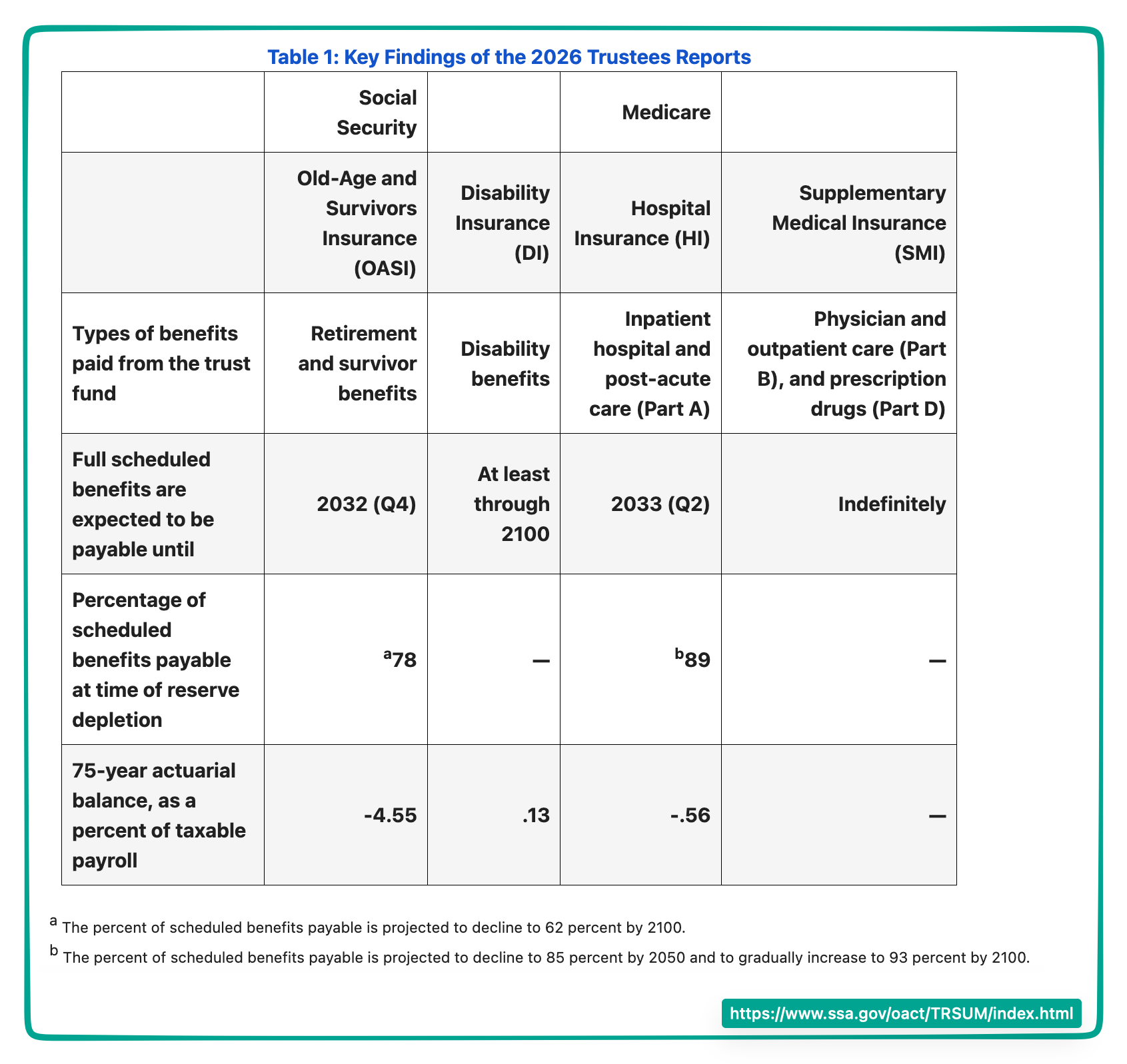
We can start with the Social Security Trust Fund. Knowing that the revenue from current workers might not be enough for current beneficiaries, the Congress buoyed the trust fund in 1983. Replenished whenever the System’s income exceeds its expenses, the trust fund is the back-up. And happily, it has been there for the extra money we’ve needed since 2021. However, if all continues as the Trustees predict, little by little, the trust fund will shrink until 2032 when it will be empty. Having inadequate income, the System’s payout would have to be 78% of “scheduled benefits.”
The problem is a deflated trust fund cushion. Unlike the past, because immigration is down, we collect insufficient payroll revenue. In addition, looking ahead, our declining fertility rate will produce fewer babies that will grow up to fund Social Security. Then, further compounding the problem, the One Big Beautiful Bill Act, by reducing taxes on benefits, shrunk Social Security revenue. Meanwhile, on the spending side, we have more baby boomer retirees that will be living longer.
The 2026 report included this summary:
Social Security Solutions
A benefit cut is projected for 2032.
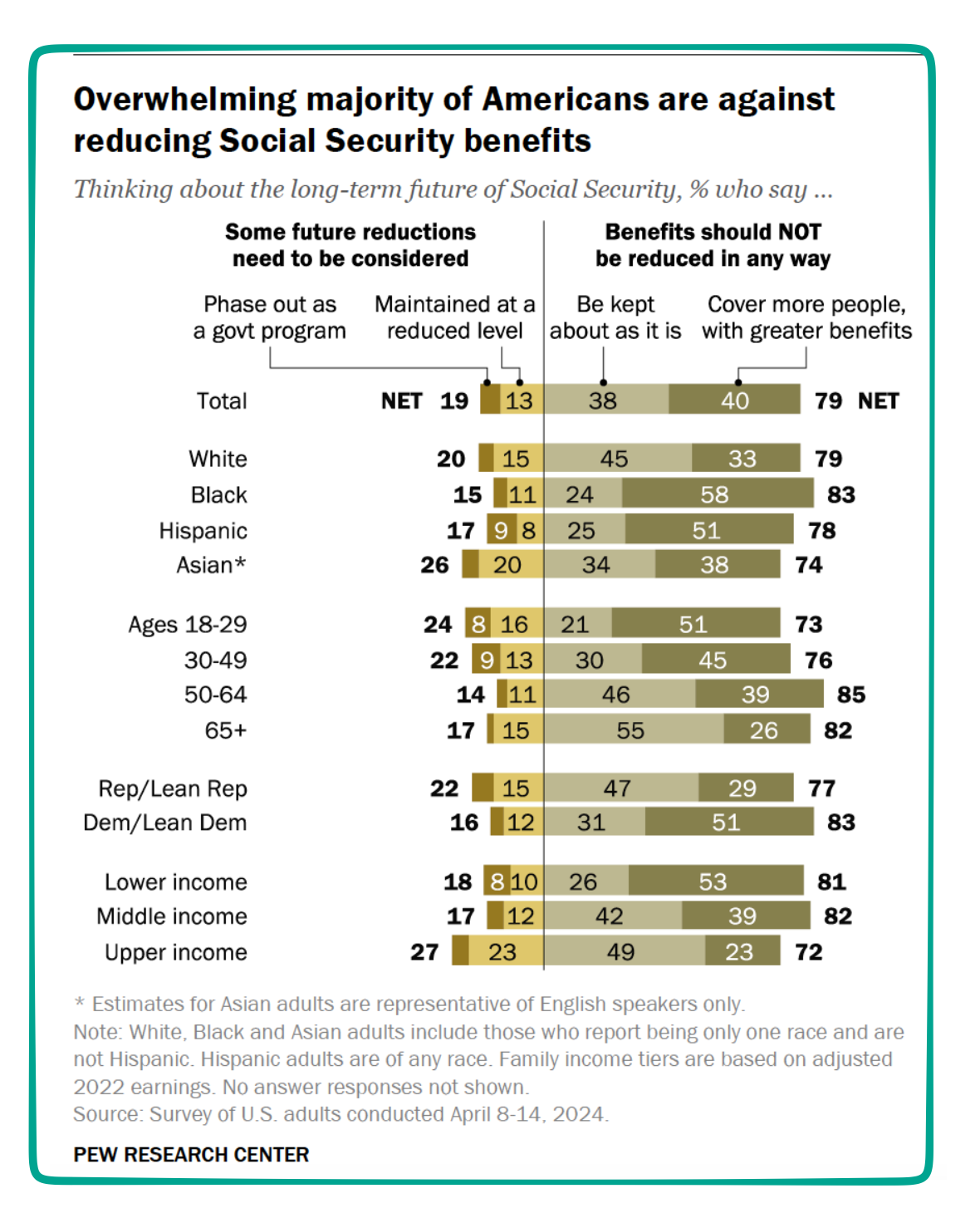
But according to a 2024 Pew Survey, benefit cuts are not the answer:
We can group the possible fixes into three categories. The Congress could increase the revenue we pay to the system. They can change the benefits. Or, they could reach into a miscellaneous grab bag of tweaks.
What you prefer can depend on the tradeoffs you are willing to make.
Revenue
Currently our payroll tax has an income cap. In 2026, you paid (or split with your employer) 12.4 percent on no more than $184,500. While the cap usually increases yearly, instead, the fix could be no cap. Also, the rate could ascend or other items could be taxed, not just income.
Benefits
Benefits could go up or down. It all depends on whether you want more for those who have less or less for everyone or more for everyone.
Grab Bag
Elevate the age that you can start receiving Social Security benefits. Privatize and allow stock market investment. Buy out wealthy individuals. Link benefits to life expectancies. Means testing.
Our Bottom Line: Public Choice Theory
Asking why the Congress and the President have been unwilling to target our looming Social Security shortfall, I thought of public choice theory. First developed by Nobel economics laureate James M. Buchanan, public choice theory explains the negative externalities of a politician’s self-interest. Because politicians engage in utility maximization, they might cater to voters who ignore national well-being.
Put all of this together and you see why Social Security has been called “the third rail of American politics.”
My sources and more: Do take a look at the Trustees Report summary and then the 273 page report. In addition, we returned to what Pew Research told us and the Econlib summary of Public Choice Theory.
Please note that several of today’s sentences were in a past econlife post.