![econlifelogotrademarkedwebsitelogo[1]](/wp-content/uploads/2024/05/econlifelogotrademarkedwebsitelogo1.png#100878)


How NASA Accidentally Spread Nutella
April 12, 2026
How We Remain Globalized
April 14, 2026
I’ve stopped using CVS as my pharmacy because of the hassle of getting a human on the phone.
Now, researchers have calculated that our hassles cost the economy billions of dollars.
Annoyance Costs
You know what I mean. Whether it’s CVS, a subscription cancellation, or scheduling a check-up, we waste massive time, energy, and money talking to chatbots, explaining problems to AI agents, and filling out forms. Instead, talking to a human would make it so much faster and easier.
Sometimes regulations are the reason. In other instances, business save money with less labor and make more money when we cannot easily cancel a subscription. Meanwhile, generic documents and technology depersonalize. They block real communication.
In a recent report, the Groundwork Collaborative quantified the impact of our daily hassles. “Dollarizing” the money, time, and irritation, they wound up with a $165.96 billion cost:
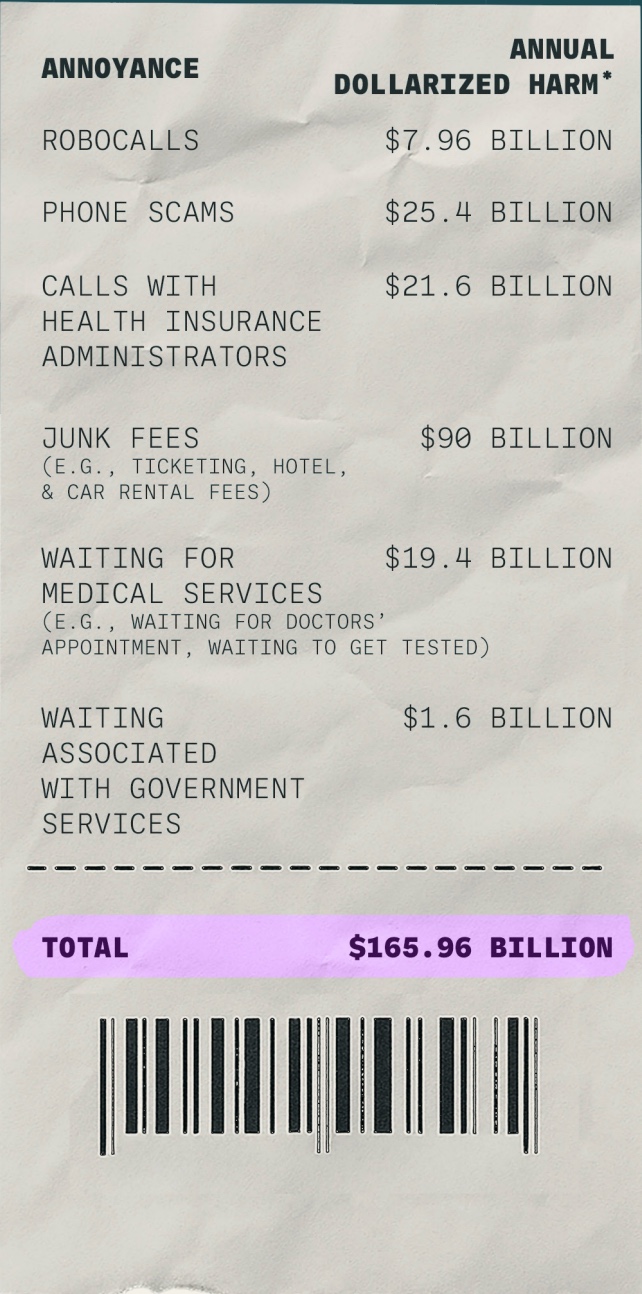
Four Dollar and Time Wasters
Among the countless possibilities, Taking On the Annoyance Economy directs our attention to four big dollar and time wasters. Looking at health insurance, spam, customer service, and junk fees, the report touches the small stuff like a spam text. But also, by exploring the annoyances from health insurance, they focus on the big necessities. Their health insurance discussion reminds us of the jargon barriers that range from “deductible, coinsurance, and copayment to HMO, PPO,” HDHP, and in-network. Even more crucially, as they specifically explore an annoyance sector, we see the universality of the topics.
We can call it friction.
Our Bottom Line: Friction
Annoyance costs are nudges that distort our decisions. We might forgo a doctor’s appointment because a question went unanswered. Application fees prevent multiple alternatives. Clicks let us buy items but cancellations require calls.
It all adds up to the friction that, like physics, slows us down.
But where does this leave us? Also known as transaction costs by economists, those annoyances constrain our economy. In Taking On the Annoyance Economy, they not only tell us what is wrong but how to fix it.
My sources and more: Thanks to the Sunday NY Times for inspiring today’s post. From there, this link provided the summary and then here is the full report.